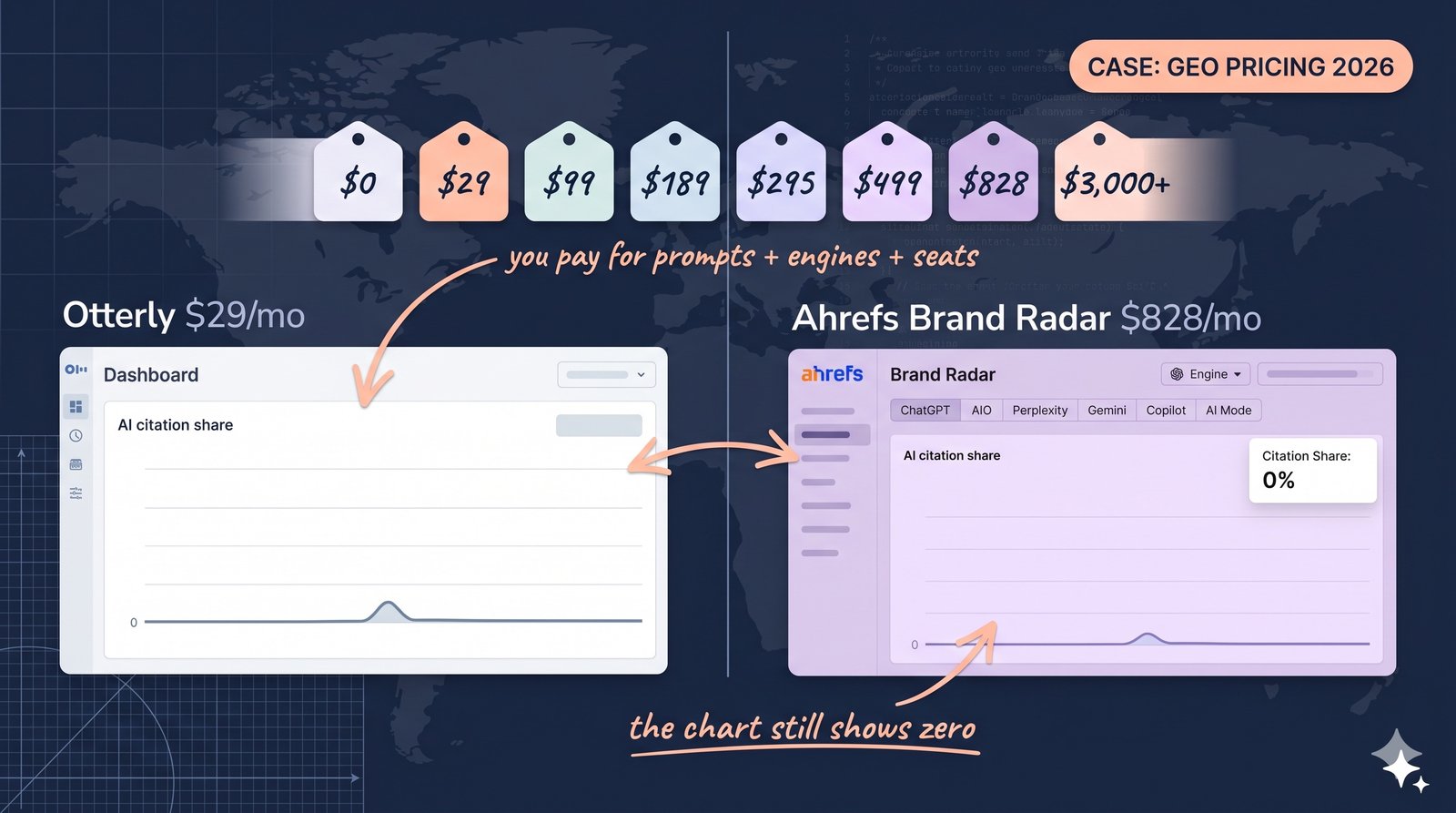
A fintech founder we audited in Q1 asked which GEO dashboard to buy. I asked which problem they were trying to solve. They didn't have an answer. They had a board update.
That's most of what the GEO-tool market is currently selling: a monthly subscription for a slide deck. The deck is genuinely useful when there's an operation behind it. Without one, the dashboard becomes the only work, and the only work is a graph of zeros.
This piece is the prices. Every public number for the dashboards that matter as of May 2026, what the next tier up actually costs once you read past the marketing page, where the per-engine and per-prompt add-ons hide, and the rule we use to decide whether $29 or $2,999 is the correct answer for a given brand.
Quick answer
Generative engine optimization tools — the GEO dashboards that track whether AI engines cite you — span a wide price range. Public entry prices run from $0 (Hall free, AirOps Solo, manual polling) to $499/mo (Profound Lite, Otterly Premium). Realistic operating tiers for a single brand monitoring 50-100 commercial prompts across four engines sit at $189-$295/mo (Otterly Standard, AthenaHQ self-serve, Peec Pro). Enterprise tiers (Evertune, Profound full, Ahrefs Brand Radar 6-engine bundle) start at $828-$3,000+/mo. Every vendor sells the same polling primitive; what you pay for is prompt volume, engine coverage, seats, history and sentiment. For the full critique of why monitoring on its own moves no needle, see our GEO dashboards vs acquisition piece. For the broader framework, SEO vs AEO vs GEO.
Why a tightly-worded pricing line gets cited more than a fuzzy one: the Claude Search citation-gap piece. And the hands-on side of producing pages like this one: the AI-for-SEO process we run.
Try this first
Open chatgpt.com in one tab and Perplexity in another. Paste 10 of your top commercial queries. Note which brands are cited and which sources the engine pulled from. Take a screenshot.
You just produced the same data Profound sells for $499/mo, for those exact 10 queries, for free. What the paid tools give you on top is automation, weekly history, deltas and a CSV. The underlying data is identical because the engines are identical.
If your brand is absent from your own screenshot, no $500/mo subscription changes that. The thing that changes it lives in someone else's site. We get to that later in the piece.
The 2026 GEO dashboard price list
Here is the actual market, sorted by realistic operating tier, with the public entry price and where the bill jumps once you scale.
| Vendor | Entry price | Realistic ops tier | Engines | Prompts at ops tier | Free trial |
|---|
| Manual polling (DIY) | $0 | $0 | All public | Unlimited (manual) | n/a |
| AirOps Solo | $0 | $2,000 (Pro) | ChatGPT only on Solo, all on Pro | 20K tasks free | yes |
| Hall | Free | "Contact sales" | 8 (incl. DeepSeek, Meta AI) | 500 (Starter) | yes |
| Otterly.AI | $29 (Lite) | $189 (Standard) | 4 (ChatGPT, AIO, Perplexity, Copilot) | 100 | yes |
| Semrush AI Visibility Toolkit | $99 | $199-549 (One bundle) | 4-6 | 25 standalone, +$60/50 extra | no |
| SE Ranking + AI Search add-on | $52 base + $89 add-on | $189-519 (SE Visible) | 4-6 | 450-1,500 | yes |
| LLM Pulse | €49 (Starter) | €99 (Growth) | 5 | included | yes (14 days) |
| Peec AI | €89/$95 (Starter) | $199-241 (Pro) | 3 incl., +$30-140/extra model | 50-500 | yes (14 days) |
| Scrunch AI | $250 (Core) | $500 (mid) | 4 on Core, 8 on Enterprise | 125 | no |
| AthenaHQ | $295 ($95 annual) | $295-499 self-serve | 8 | 3,600 credits/mo | no |
| Snezzi | $299 | $999 (Growth) | 5 | Tracking + content bundled | yes (7 days) |
| Profound | $99 (Starter) | $499 (Lite) | ChatGPT on Starter, 4 on Lite | 50 on Starter | no |
| Ahrefs Brand Radar | $129 base + $199/index | $828 (base + 6-engine bundle) | 6 | "you're mentioned" included, +$50/2,500 custom | no |
| Evertune | Custom | ~$3,000+ | All | Custom | no |
| Similarweb AI Search Intelligence | Custom | Custom | Custom | Custom | yes |
Prices verified from vendor sites, vendor help-centre docs and third-party trackers (Trakkr, G2, Analyze AI, Capterra) on 2026-05-26. Annual billing typically lops 15-17% off the monthly rate.
Group 1: dedicated GEO dashboards
The pure-play monitoring vendors. Same primitive (poll AI engines on a query set, log citations, render charts) with different UI and seat policies.
Profound publishes a $99/mo Starter plan, but the Starter tier covers ChatGPT only and 50 prompts. Operator reviews on Trakkr and G2 flag the realistic floor as the $499/mo Lite plan, where you get the four main engines plus prompts at scale. No free trial. No self-serve over Lite. Full platform coverage, API and unlimited seats sit behind enterprise pricing reported in the $2,000-5,000+/mo range. Profound is what you buy when there's already an in-house or agency operation running and you want one polished dashboard for the board call.
Otterly.AI is the budget option that still does the job. $29/mo Lite (15 prompts), $189/mo Standard (100 prompts), $489/mo Premium (400 prompts). All tiers track ChatGPT, Google AI Overviews, Perplexity and Microsoft Copilot. Annual billing knocks 15% off (so $25, $160, $422). Add-ons are honest: $9-149/mo each for AI Mode and Gemini, $99/mo for an extra 100 prompts. If you operate a single brand on a small query set and just need a weekly chart, this is the floor.
Peec AI lives in the middle of the market. €89/mo Starter, $199-241/mo Pro, $499+/mo Enterprise. Includes three AI models per plan; extra models are $30-140/mo each. Daily tracking, unlimited seats, agency tier from $245/mo. Competitive benchmarks are the strongest module. Use it when comparing share of citation against named competitors matters more than absolute count.
AthenaHQ uses a credit system. $295/mo standard self-serve, $95/mo on annual billing, 3,600 credits per month where one AI response equals one credit. Eight engines covered (ChatGPT, AIO, AI Mode, Perplexity, Claude, Gemini, Copilot, Grok). No free trial. The credit model is honest math: 100 prompts ran across 8 engines is 800 credits per probe, so a biweekly cadence eats 1,600 credits/mo before anything else. The upside: everything is in one tier. The downside: planning your monitoring cadence becomes a spreadsheet exercise.
Hall has a free baseline tier and paid plans from $29/mo. The published tiers (Starter, Business, Enterprise) carry feature limits (20-50 projects, 500-1,000 tracked questions, 45K-120K analysed answers per month) but the actual prices on Starter and Business sit behind "contact sales". Tracks eight engines including DeepSeek and Meta AI, which most competitors skip. Strongest at sentiment and share-of-voice rendering. Worth a trial if you have to monitor across many small projects (agency case) or if non-Western engines are commercially relevant.
The pure-play tier looks crowded because it is. Most of these vendors consolidate or pivot by 2027.
Group 2: SEO suites that added an AI module
If you already pay Semrush, Ahrefs, Similarweb or SE Ranking, the GEO module is sometimes an add-on rather than a separate subscription. Total spend is usually higher than the dedicated dashboards because you're paying for the underlying SEO suite too.
Semrush AI Visibility Toolkit publishes at $99/mo standalone with one domain and 25 custom prompts (Semrush KB 1493). The add-ons stack: +$60/mo per 50 extra prompts, +$99/mo per domain, +$99/mo per subuser. The Semrush One bundle (SEO + AI Visibility + advanced analytics) starts at $199/mo Starter, $299/mo Pro+, $549/mo Advanced. Annual billing reduces ~17%. No free trial on the AI Visibility Toolkit standalone; 14-day free trial on the Starter and Pro+ bundles. The bundle is the right call if you were going to buy Semrush anyway and the AI module saves a separate Otterly or Profound subscription.
Ahrefs Brand Radar is the priciest one once you actually use it. The add-on costs $199/mo per individual AI index OR $699/mo for the 6-platform bundle (Google AIO, AI Mode, ChatGPT, Perplexity, Gemini, Copilot), on top of a base Ahrefs subscription that starts at $129/mo. Realistic minimum cost for the working version: $828/mo. The custom-prompt tracker (the part that lets you proactively check non-branded queries you select yourself) is an additional $50/mo per 2,500 prompts. Ahrefs has the deepest data substrate of any vendor on this list. You pay for that.
SE Ranking is the budget option in the SEO-suite bucket. AI Search add-on is $89/mo on top of a $52/mo base plan (real combined cost $150-240/mo). The standalone SE Visible product runs $189/mo for 450 prompts, $355/mo for 1,000 prompts and 10 brands, $519/mo for 1,500 prompts and 15 brands. All plans include unlimited user seats. The trade-off is engine coverage and UI polish; SE Visible covers fewer engines than AthenaHQ or Profound and the dashboard reads as functional rather than polished.
Similarweb AI Search Intelligence is sales-led. No public pricing on the package page. Third-party reviews suggest entry tiers in the $99-399/mo range with broader Similarweb suite tiers higher. The platform's strength is connecting AI traffic and brand visibility to the wider competitive intelligence data Similarweb already owns. Worth a quote if you already use Similarweb for market research and want the AI layer alongside.
Group 3: new entrants and execution-blended tools
The category is still adding vendors every month. Three patterns to watch.
Scrunch AI launched at $250/mo Core, $500/mo mid, custom Enterprise. Core covers four engines (ChatGPT, AIO, Perplexity, Copilot) and 125 prompts. Claude, Gemini, Meta AI and Grok sit behind Enterprise. The differentiator is the site-audit module (5 audits/month on Core) which surfaces crawlability and structured-data gaps that block AI retrieval. Reviewers note the insights side is still beta, so the actionable layer needs a human pass before it informs work.
LLM Pulse has the clearest self-serve pricing in the category. €49/mo Starter (5 models, 1 project, 3 competitors), €99/mo Growth, €299/mo Scale. 14-day free trial with unlimited seats on every tier. Weekly tracking by default. Built by a founder who runs a citation business himself; in the r/AISearchLab discussion on GEO metrics from early 2026, LLM Pulse's Daniel Peris noted that they see "more leads telling us they discovered us through ChatGPT than measurable traffic coming from ChatGPT". That gap is the use case for this tier of tool: catching the demand signal that doesn't show up as referral traffic in GA4.
Evertune is enterprise-only. No public pricing. Reported $3,000+/mo entry per third-party trackers and aimed at Fortune 500 CMOs. The product is solid (sentiment analysis, AI Brand Index, shopping intelligence for product recommendations). The price ceiling reflects positioning more than technology.
Snezzi is a hybrid: tracking dashboard plus AI content production bundled together. $299/mo entry, $999/mo Growth (50 prompts tracked plus 10 optimised articles/month), $1,999/mo Aggressive. Three-month minimum on the higher tiers. Closer to an agency-with-dashboard than a pure SaaS. Useful only if you actually want the content production half; otherwise the dashboard portion overlaps with Otterly Standard at half the price.
AirOps is the content-workflow tool with light AI visibility analytics on the side. Solo plan free with 20,000 workspace tasks and ChatGPT-only insights; Pro plan $2,000/mo for multi-engine analytics and team collaboration; Enterprise custom. Overage fees are $9 per 1,000 tasks on Solo, $6 on Pro. Use it when your team's actual problem is content production at scale and AI visibility tracking is a secondary feature.
Group 4: the free DIY option
Manual polling still works in 2026. The cost is your time. The data is identical to what the dashboards sell because the dashboards poll the same public engines.
The DIY routine that produces 80% of the value:
- Maintain a sheet of your top 25-50 commercial queries. Define "commercial" as queries a buyer types after they've decided they need your category, with intent to compare or shortlist.
- Once a week, paste each query into ChatGPT, Perplexity and Google AI Overviews. Log which sources are cited and which brands are named in the answer.
- Run a separate sweep for brand-comparison queries ("X vs Y", "alternatives to X"), since those return different source mixes.
- Track the trend with a single column per week.
Most operators we know were on this routine through mid-2026 before the dashboards launched. The r/AISearchLab thread on GEO metrics flagged the same point: every GEO metric is modelled rather than directly measured, no major AI platform exposes official analytics for brand mentions, and the "Citation Share" or "Winner Rate" charts dashboards render are statistically thin unless each prompt is sampled at high frequency. One vendor founder in that thread (Evertune) noted they sample each prompt 100 times to reach significance. A weekly manual sweep of 25 queries is roughly the same fidelity as a paid tool polling 100 prompts at low frequency.
DIY breaks at the agency case (>5 brands tracked in parallel) and the historical-data case (you want a six-month trend line on day one). For those, pay.
What the price actually buys
The pricing pages won't tell you this in one paragraph, so here it is. Same product across every dashboard in groups 1-3. A query loop that asks AI engines on your behalf and counts which sources got cited. The price differences come from six features:
- Prompt volume. 15 vs 50 vs 100 vs 400 vs 1,500 prompts per month, on whatever cadence the tier supports.
- Engine coverage. Four engines (ChatGPT, AIO, Perplexity, Copilot) is the base set everyone has. Claude, Gemini, AI Mode, Grok, DeepSeek and Meta AI are progressively gated as you climb tiers.
- Seats and projects. Solo brand vs multi-brand vs agency multi-client.
- History and cadence. Daily or weekly polling, 30-day vs 12-month historical retention.
- Sentiment and parsing. Whether the tool tells you the citation was flattering or unflattering, and what the surrounding framing looked like.
- Reporting layer. Looker Studio connectors, white-label PDF exports, board-deck output, API access.
That is the entire feature axis. Pick the cheapest tier that gives you the prompt volume, engines, sentiment depth and history you actually need. Nothing else differentiates.
The hidden costs that don't show on the pricing page
Three places the bill jumps after the contract is signed.
Engine add-ons. Otterly's $9-149/mo for Gemini or AI Mode. Peec AI's $30-140/mo for each model over the included three. Ahrefs Brand Radar's $199/mo per AI index unless you buy the $699 bundle. These look small until you realise the Starter plan didn't include the engine your buyers actually use.
Prompt add-ons. Semrush's +$60/mo per 50 extra prompts, Otterly's +$99/mo per 100, Ahrefs's +$50/mo per 2,500 custom prompts. If you started by tracking 25 commercial queries and your category has 80, you'll cross the threshold inside a quarter.
Seat and domain add-ons. Semrush charges $99/mo per additional subuser and $99/mo per additional domain on the AI Visibility Toolkit. An agency tracking three clients on Semrush is paying ~$99 × 3 domains + $99 × 2 extra users on top of the $99 base, before any prompt overage. Realistic mid-tier bill on a 3-brand agency setup lands closer to $700/mo than $99.
Read the per-engine, per-prompt and per-seat lines on every vendor's pricing page before you commit. Then add 30%.
Three rules for picking the tier
How we actually advise the brands that ask. Adjust to your case.
Rule 1. Buy below your operation, not above it. If you don't have a content team, Reddit residents, PR vendor or agency producing public signals on a weekly cadence, no dashboard helps. Skip the subscription, run the DIY routine, spend the budget on the operation. A dashboard tells you whether the work is landing. If there is no work yet, there is nothing to land.
Rule 2. Match prompt volume to query universe, not aspirational coverage. If your category has 30 commercial queries that matter, a 50-prompt plan is correct. Buying the 1,500-prompt plan to monitor every adjacent variation is a tax on your CFO. Most buyers ask 8-15 variations of the same intent; you're paying to monitor synonyms.
Rule 3. Pay for sentiment or pay for nothing. Bare citation counts are noise without context. A citation that frames your brand as the expensive option inside a price-conscious answer is a negative outcome the dashboard rendered as a positive. Sentiment parsing (Hall, Evertune, Peec at higher tiers, Otterly Standard upward) is where the analytic layer starts earning its price. If sentiment isn't in your tier, you're paying for a counter.
When a dashboard is worth its price
A GEO dashboard earns its subscription under three conditions.
You already run an acquisition operation (in-house residents, agency content production, Reddit and forum work, ongoing PR) and you need to measure whether it's working at the AI-citation layer. The dashboard is the closed-loop instrument; the operation is the engine. Without the engine, the instrument shows zero.
You manage three or more brands and need to compare them in one view. The agency case is where multi-client dashboards (AthenaHQ, Peec, Hall) earn their seat-count math.
You face a quarterly board call that wants a defensible visibility chart. Legitimate use of the spend. Just be honest internally that the dashboard is a slide-deck input, and put the actual work-allocation budget against the operation that moves the chart, not the dashboard that draws it.
The case where a dashboard does not earn its price: a single-brand SMB with no execution operation, where the dashboard subscription is being framed internally as the GEO strategy. We have audited several of these in fintech and SaaS verticals in Q1 2026 (the 240 commercial-query sample described in our methodology). The pattern is identical. Brand pays $189-$499/mo for 90-180 days, watches a flat zero on the chart, churns the subscription, concludes (incorrectly) that GEO doesn't work. The dashboard was reporting correctly. The brand had no operation behind it.
For where the operation actually lives, see how to get cited by Perplexity, ChatGPT and AI Overviews and our Reddit Resident Network for the conversational source layer Perplexity and AI Overviews pull from. For B2B execution-side context, see LinkedIn Resident Network. And Reddit owns Google for crypto covers why the same engines lean disproportionately on community sources in vertical commercial queries.
Frequently asked
Is there a single best GEO dashboard in 2026?
No. The right vendor depends on your operation size, query universe and engines that matter to your buyers. Budget single-brand at small query volumes: Otterly Standard ($189/mo). Mid-market with execution running and 100+ queries: AthenaHQ self-serve ($295/mo) or Peec Pro (~$199-241/mo). Agency multi-brand: Peec Agency ($245+) or AthenaHQ. Enterprise with budget for sentiment depth and engine breadth: Ahrefs Brand Radar bundle ($828/mo) or Evertune custom.
What's the cheapest GEO tool that does the job?
Otterly.AI Lite at $29/mo if 15 prompts is enough for your category. Hall at $0 free tier for a feature-gated baseline. LLM Pulse at €49/mo if you want a real 14-day free trial first. Manual polling at $0 if your time is cheaper than the subscription.
Do I need a GEO dashboard if I already pay for Semrush or Ahrefs?
The Semrush AI Visibility Toolkit at $99/mo standalone is the cheapest way to add the AI layer without leaving the existing tool. Ahrefs Brand Radar is only economic at the $828/mo full bundle, so unless you specifically need that data substrate, an Otterly Standard subscription paired with manual Ahrefs queries is the cheaper path.
How long do I need to subscribe before the chart moves?
The dashboard tells you what's there. The dashboard does not move what's there. AI citation curves move on 60-180 day timelines once an execution operation is producing public signals (Reddit threads, comparison pages, third-party mentions, founder content). If you subscribed expecting the chart itself to nudge anything, refund inside the trial.
Are any of these tools likely to consolidate or shut down?
Yes. Most of group 1 (the pure-play dashboards) get acquired by SEO incumbents or pivot to execution-blended models within 12-18 months. The polling primitive is too thin to support 10+ independent SaaS at scale. Hedge by avoiding annual contracts on standalone dashboards unless they offer >20% discount or month-to-month exit.
Can a GEO dashboard show me how to actually get cited?
Partly. It can identify which Reddit threads and third-party sources are cited for your category, which is the input for an acquisition strategy. The execution itself (writing in those threads with karma history, building canonical comparison pages, getting cited by domain editors) is a separate operation. See our Reddit Resident Network for what that looks like, and Google's AI decision layer for the engine-side context on why Google rewards this kind of evidence.
Want a 20-minute citation snapshot for your top commercial queries that costs $0 and doesn't require a dashboard subscription? Run an audit with us. We'll pull Perplexity, ChatGPT and Google AI Overviews on your queries live, show you which Reddit and forum sources own them, and you'll know inside the call whether any dashboard on the price list above is worth its number for your case.