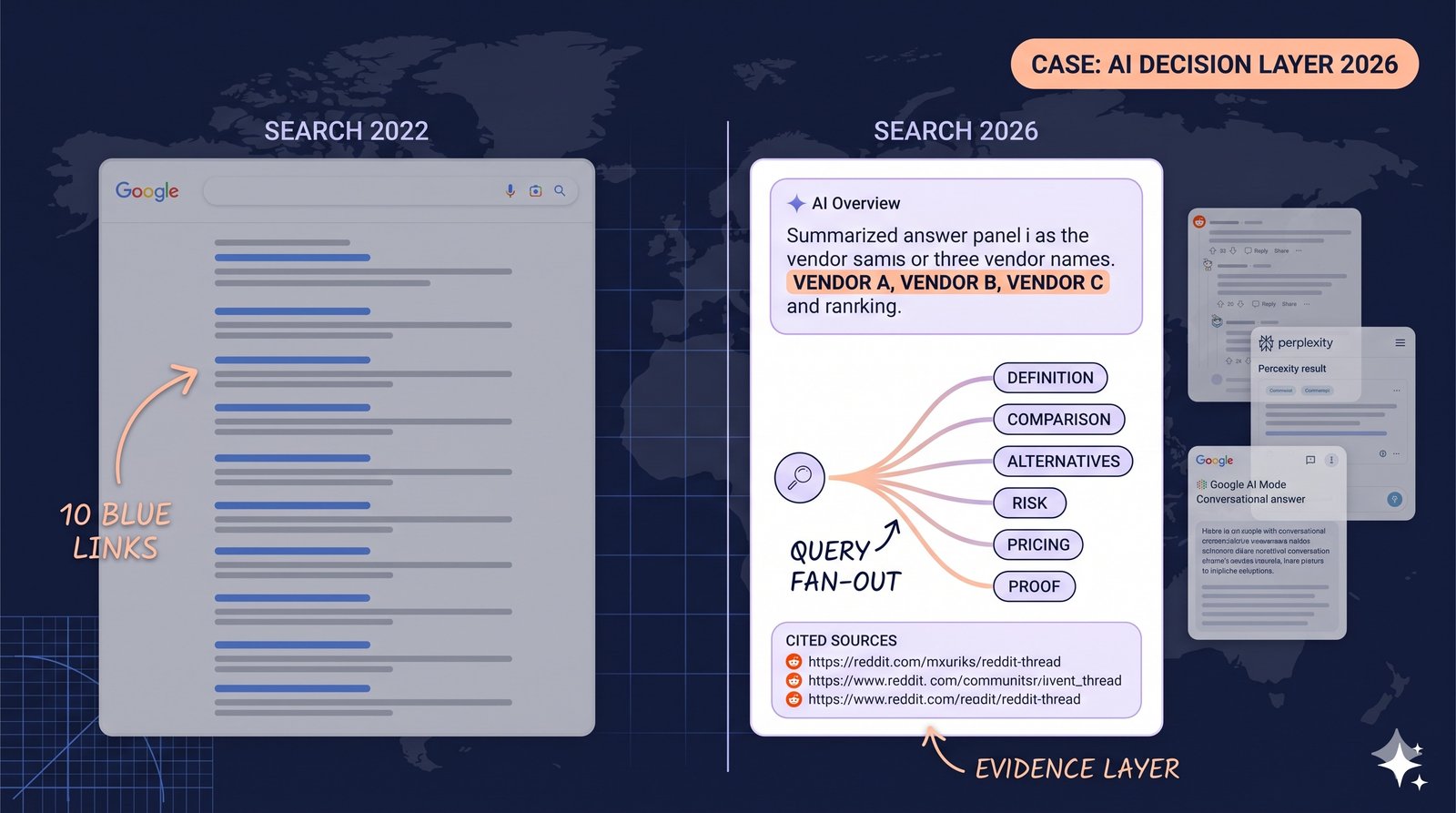
Google rolled out the May 2026 core update on May 21, four days after its biggest AI Search announcements at I/O 2026. SEO Twitter is treating these as two separate events. They look like the same one.
The update changes more than where links appear. It changes the kind of evidence that gets used when Search becomes an answer, a shortlist or an agentic action. Brands that treat it as another ranking shuffle will spend the rest of the quarter chasing the wrong fix.
Quick answer
Google's May 2026 core update and the I/O AI Search announcements point in the same direction. Search is moving from page-matching toward evidence evaluation. Brands chasing citation share with thin content lose. Brands maintaining useful first-party information backed by public evidence become easier for AI Search to retrieve, extract and recommend. The durable fix lives in building evidence inside places Google's models can verify, which formatting alone never reaches. Buyer-journey context: The AI Silent Committee. Framework: SEO vs AEO vs GEO.
What actually happened (the boring facts first)
A quick recap so the rest reads cleanly:
- The May 2026 core update started rolling out May 21 and may take up to two weeks to fully propagate, per the Google Search Status Dashboard.
- This is the second core update of 2026 after the March 2026 update, tracked by Search Engine Land.
- At I/O 2026, Google announced a new AI-powered Search box, agentic features in Search and AI Mode as a top-level surface, recapped on blog.google.
- AI Mode crossed 1 billion monthly users, with AI Mode queries more than doubling each quarter per Google's own I/O announcement count.
- Google published a guide to optimising for generative AI features which is explicit that AI Overviews and AI Mode lean on the same Search index, ranking and quality systems.
- Google's docs for AI Features and Your Website describe query fan-out, where one complex query gets decomposed into multiple sub-queries against different subtopics and sources.
- Google added back-button hijacking to its spam policies with enforcement starting June 15, 2026.
- Gemini 3.5 Flash and a broader Gemini redesign were also part of the I/O cycle, covered by The Verge.
That's the factual surface. The interesting part is what these point at collectively.
Google's official message is boring on purpose
Read the AI Optimization Guide carefully and Google's position is almost defensive: SEO fundamentals still matter, AI features run on the same Search infrastructure, the same quality signals apply. The tone is "nothing to see here, keep doing good work".
That message is correct and incomplete at the same time.
What stays the same: the underlying ranking and quality systems. What changes: the surface those systems feed into. A Search result used to be a list of links the user evaluated. The same systems now feed an answer the user reads, a shortlist the user trusts, or an action an agent takes on the user's behalf. The fundamentals haven't shifted; the way those fundamentals get consumed has.
So "SEO still matters" is true and a little misleading. SEO as a discipline of optimising one page for one keyword is being slowly replaced by a wider surface where rankings, extraction, citation, recommendation and agentic action are different jobs that share signals. Google's documentation is starting to describe that surface; the Core Updates docs hint at it without naming the broader category.
Query fan-out changes content strategy in a way most teams haven't absorbed
The single most important technical claim in the AI Features doc: one prompt gets decomposed into many sub-queries before any sources get cited. Search Engine Journal's 2025 research (summarised in Wellows' fan-out guide) puts the typical fan-out at 12-15 sub-queries per AI Mode answer, with complex queries expanding to 50+ variations. Position Digital's 2025 data shows pages addressing 5+ fan-out sub-intents have a 3.2x higher citation probability than pages targeting only the head term.
The old SEO unit of work:
one page → one keyword
The new AI Search unit of work:
one prompt
   → many sub-queries (definition, comparison, risk, alternatives, pricing, proof)
   → many candidate sources per sub-query
   → synthesised answer pulled from the strongest sources across all sub-queries
Practical implication: a brand can rank well for "best [category] tool" and still be invisible in the AI Mode answer for the same query, because the fan-out also generated sub-queries for "[category] alternatives", "is [vendor] legit", "[category] for [specific use case]" and pulled stronger sources for those.
The content strategy that survives this asks something different of you. Instead of writing one stronger page per keyword, you cover a cluster of intents around the same buyer question, with each piece doing one thing well and linking explicitly to the others so the engine can stitch the cluster together.
This is the structural reason "Reddit GEO" or "AI search visibility" cannot live on one landing page. We've split our own cluster across Reddit GEO, Reddit & AI Search, Reddit marketing agency, Reddit reputation and the supporting blog articles for exactly this reason. Each piece answers a different sub-query the fan-out produces; together they cover the surface the AI Mode answer is built from.
Low-evidence content is the real target
Most of the discussion of recent Google updates frames them as "Google penalising AI content". That reading misses the point and Google itself has explicitly said helpfulness matters more than production method.
Google's quality systems are getting better at distinguishing content that adds evidence from content that just rearranges existing material. Production method correlates with that distinction without being the variable Google's systems measure.
| Low-evidence content | High-evidence content |
|---|
| Rewrites existing articles | Adds field observations |
| Optimised for citation tricks (schema spam, llms.txt overload) | Answers the actual buyer question end-to-end |
| Generic definitions and overviews | Specific examples with named entities |
| No public proof or external references | Links to evidence, forums, reviews, primary sources |
| Static page, "updated" only by tweaking the date | Maintained page with fresh public signals around it |
| Brand voice only | Mix of brand voice and quoted external context |
A 2,500-word AI-generated article that synthesises ten other articles will tend to lose to a 1,200-word article that includes one original data point, two named-source citations and a clear methodology note. The first competes against everything else the AI has already seen; the second contributes something the AI didn't have before. Google's quality systems can tell the difference more than they could in 2024.
Evidence building is the half of GEO that lasts
The first wave of GEO advice is converging on a shared playbook: definition blocks at the top, FAQ at the bottom, comparison tables in the middle, schema markup everywhere, entity mentions throughout, llms.txt at the root, dated freshness signals on republished pages.
All of that helps at the margin. None of it is hard to copy. By Q4 2026 every reasonably-equipped marketing team will be doing it, and the formatting layer of GEO will be a commodity. Doing the formatting work well is becoming baseline competence; the actual differentiation lives somewhere above it.
What doesn't commoditise: the public-evidence footprint Google's models look at to decide whether the formatted content is real. That footprint takes months to build, can't be retrofitted in a weekend, and is operational rather than editorial. The brands that win citation share through 2027 will be the ones running a credible evidence operation in parallel with their on-page work, not the ones who shipped the prettiest definition blocks.
That's where dashboards stop being useful, which we cover in why 12 GEO dashboards won't get you cited by Perplexity.
Public evidence is the missing layer for most brands
If we drew the trust-source priority list that AI Search uses for category and comparison queries, brand-owned pages sit at the bottom. The reasoning is plain: a vendor describing its own product carries built-in bias the AI tries to discount, and twenty independent users agreeing on a recommendation in a Reddit thread carry the multi-source confirmation signal the AI weights heaviest.
Your website tells Google what you claim. The public evidence layer tells AI Search what the market actually confirms about you.
Public evidence in 2026 spans:
- Reddit threads with real engagement (the dominant source for most consumer and B2B research categories)
- Quora answers with multi-user agreement
- Niche category forums for verticals where Reddit is thin
- Review platforms (G2, Capterra, Trustpilot for general B2B; specialised sites per vertical)
- Comparison pages on third-party blogs
- YouTube transcripts where video is the dominant format
- LinkedIn posts from credible operators
- Directories and category indices
Where the previous SEO cycle rewarded brands that wrote the most content, the AI Search cycle rewards brands that build the most evidence. Same craft running on a different unit of work. We get into the Reddit side of this in Reddit owns Google for crypto queries and the operator framing in The AI Silent Committee.
Why Reddit spam will backfire harder after this update
A side effect of Google's quality systems getting better at evidence evaluation is that the inverse signal also gets stronger.
When Google can tell evidence-backed content from synthesised content, it can also tell credible community engagement from astroturfed engagement. A Reddit thread with twenty real users agreeing carries the citation; a Reddit thread with twenty newly-created brand-tagged accounts upvoting itself carries a sub-level ban and a brand-domain note in Google's trust signals.
This is why the cheap "buy Reddit posts" services are running out of road. They produced evidence pollution that AI Search couldn't distinguish from the real thing in 2023. By mid-2026 the distinguishability has improved measurably, and the asymmetry of penalty is brutal: a credible operation compounds over months, but a single sub-ban for spammy behaviour shows up in the brand's footprint for years and gets readable by AI Search as a credibility flag. We get into the operational difference in Reddit ads cut CPA 15% but won't fix your AEO and the safety side in our residents safety playbook.
The brands paying $3K/month for "we'll post on Reddit for you" services are buying their own future Google penalty.
What brands should actually do after the May 2026 update
The first move is calm. Google's own Core Updates guidance recommends waiting at least a week after rollout completes before analysing impact. The two-week rollout means honest analysis starts around June 5-10 at earliest.
Here's the 8-step audit we run for clients after every core update. None of it is novel; doing all of it in order matters more than picking the clever one.
1. Wait for rollout completion + 1 week
2. Segment pages: product, comparison, GEO/AI articles, Reddit cluster, old blog
3. Compare correct date ranges (before May 21 vs after rollout completion)
4. Map query fan-out coverage per cluster (definitions / comparisons / objections / use cases)
5. Add extractable blocks where missing (Quick answer, tables, checklists, FAQ, methodology)
6. Audit evidence layer (original data, named examples, public-source links)
7. Build the public-evidence layer (Reddit, reviews, directories, third-party mentions, LinkedIn from credible operators)
8. Avoid: mass AI rewrites, fake freshness timestamps, schema spam, link flooding, back-button manipulation
Step 7 is the one where most teams now lose the credibility layer by automating it. The reply-rate gap between AI SDR outreach and operator-voice outreach on LinkedIn (1% vs 15% across our 12-pool cohort) is the difference between evidence Google parses as templated outreach and evidence Google parses as a real operator vouching for your category.
Step 8 has a new line item this cycle. Back-button hijacking is now in Google's spam policies with enforcement starting June 15, 2026. Sites still doing it have three weeks to fix the issue or wear the manual action.
Step 4 is the one most teams skip and the one that moves the most. The query fan-out per cluster is the new unit of analysis, replacing the per-keyword position tracking of the old SEO era. Tools haven't caught up yet; manual probing across Perplexity, ChatGPT search and Google AI Overviews is still the cleanest way to map it.
Frequently asked
Is the May 2026 core update bigger than the March one?
Too early to call definitively. Volatility tracking from Search Engine Land and third-party rank trackers will publish comparable numbers around the rollout completion date. Anecdotally we're seeing larger movement on category-research and comparison queries (the surface AI Mode pulls from heaviest) than on transactional or local queries. Wait for the full data before making structural changes.
Did Google officially recognise GEO as a discipline?
Not in those terms. Google published an AI Optimization Guide covering generative AI features, but the guide stays inside Google's existing "helpful content" framework rather than naming GEO or AEO as separate categories. The framing is "AI features run on Search; do good Search work" rather than "here is a new discipline". That's a deliberate position from Google's side and worth respecting in how you describe the change internally.
Are AI Overviews really driving most of the click loss?
The click-loss story is well-documented at the industry level (multiple SparkToro and Similarweb analyses through 2024-2026) but specific percentages get repeated without source attribution. We avoid quoting a single number without a verified citation; the directional pattern is clear and material regardless of which specific figure is true. The category to track is zero-click commercial informational queries, not raw traffic to your site.
Should I optimise for AI Mode specifically?
AI Mode shares signals with the rest of Search and the I/O announcement made clear it's becoming a top-level surface rather than a sidebar feature. Separate optimisation for AI Mode rarely pays off when your content is already easy to extract, well-cited and supported by public evidence; the same setup covers AI Overviews, Perplexity, ChatGPT search and Reddit Answers at the same time. The cluster strategy works across surfaces.
How fast will the public-evidence layer matter more?
It matters now. The trajectory from 2024 through mid-2026 has been a steady increase in third-party evidence weighting in AI answers; on our internal probing across 240 commercial queries (full methodology block here) brand-owned comparison pages were in the top three cited sources only 8% of the time in Q1 2026. The remaining 92% came from third-party sources, most of them Reddit. We expect that ratio to widen further through 2027 as AI Search continues to outweigh interest-conflicted sources.
What's the single biggest change a marketing team should make this quarter?
Stop thinking in keywords; start thinking in question clusters. For each commercial question your buyer is asking, write the cluster: the definition, the comparison, the alternatives, the objections, the use case, the proof. Cross-link them explicitly so the AI fan-out can reach the whole cluster from any sub-query. That single shift outperforms any individual piece of formatting advice you'll read this quarter.
Where does paid spend fit into all of this?
Paid AI Search ads (ChatGPT Ads, Reddit Ads) work for direct response in a 14 to 30 day window. They don't influence the cited sources inside organic AI answers; AI engines explicitly down-weight content they can identify as sponsored placement. Run paid for velocity, run organic for citation share, measure them on different KPIs. We covered the math in Reddit's AI ads cut CPA 15% but won't fix your AEO and the broader citation playbook in how to get cited by Perplexity, ChatGPT and AI Overviews.
Methodology
The 240-query commercial sample referenced throughout this piece is one of two first-party datasets we maintain quarterly. Sample selection: 240 commercial-intent queries (40 per vertical × six verticals: crypto, fintech, iGaming, SaaS-evaluation, VPN/privacy and B2B services). Each query gets run across Perplexity, ChatGPT search and Google AI Overviews; for every answer we log the cited source list, whether at least one Reddit thread appears, and whether a brand-owned comparison page makes the top three. The 8% / 92% / Reddit-dominance figures used in this article are pulled from the Q1 2026 cohort.
The companion dataset (60 enterprise B2B prospect interviews, same verticals, Q1-Q2 2026) is used in our sibling article on The AI Silent Committee; both audits run on the same quarterly refresh cadence so the numbers stay current.
If you want the underlying query list or a redacted methodology note, the audit-team Telegram is the fastest path.
This article is also published on Medium.
The honest take
The May 2026 core update reads better as a directional signal than as a panic event.
Google is openly building toward Search as an AI decision layer where ranking, extraction, citation, recommendation and agent action are different jobs that share signals. Brands that win the next 18 months will treat their content and their public-evidence footprint as a single operation rather than as two separate budgets. Anyone trying to win the cycle on cleverer formatting and faster AI rewrites compounds in the wrong direction.
The cheap version of the response is to keep doing what worked last year. The durable version is to start building evidence in the places the AI is already pulling from, before the formatting layer commoditises and the gap between brands who did this work and brands who didn't widens further.
Want a structured audit of where you sit after the rollout? Get a free 48-hour citation snapshot. We re-run our 240-query commercial sample for your category across Perplexity, ChatGPT search and Google AI Overviews, identify the public-evidence sources currently shaping your shortlist visibility, and show where the public-evidence layer needs work after the May 2026 update settles. The full service framing lives at Reddit GEO and the agency view at Reddit marketing agency.