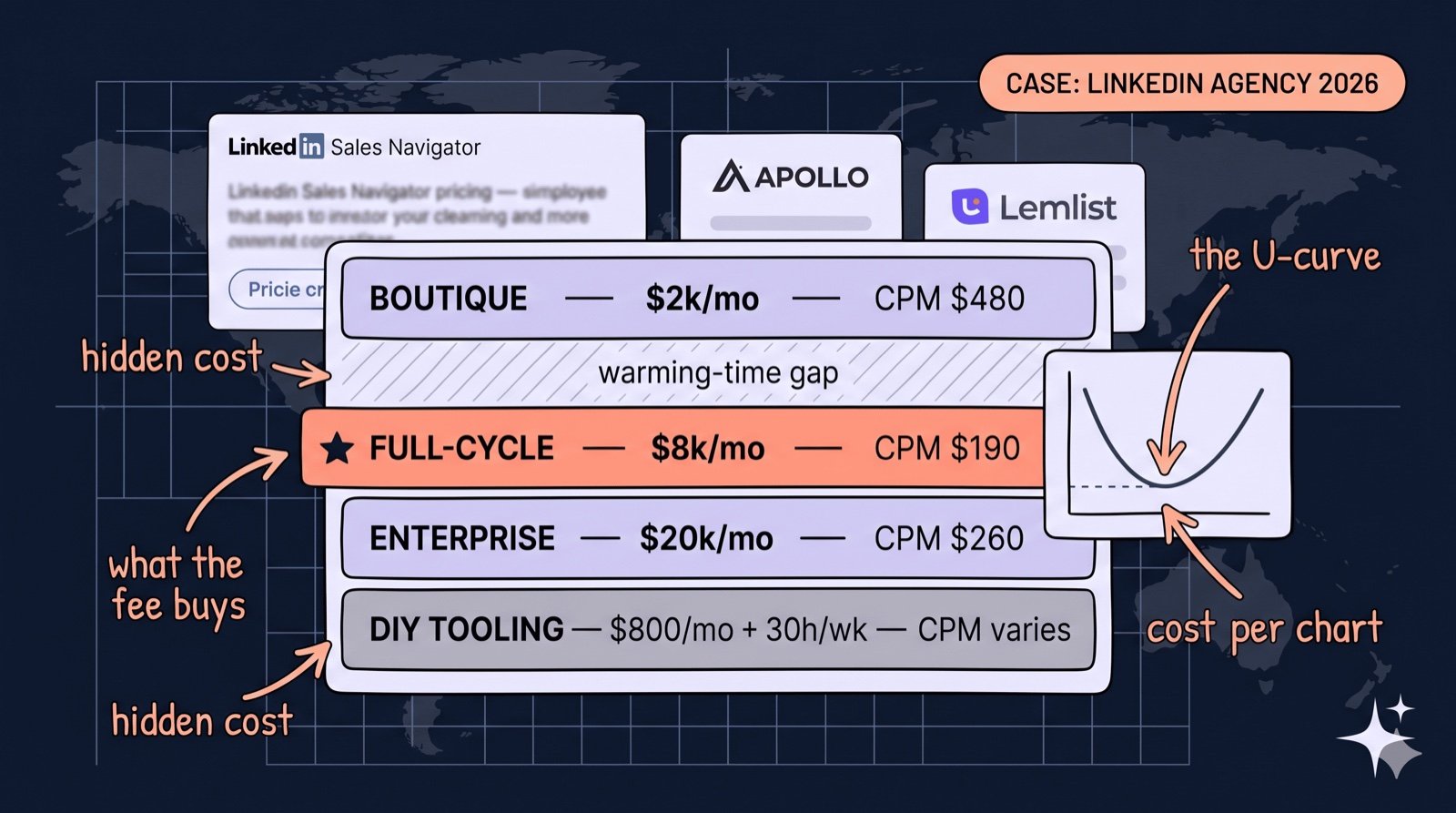
A B2B SaaS team we audited in Q2 2025 paid $2,400 a month to a boutique outreach shop. Twelve months later they had spent $28,800 plus $14,000 in Sales Navigator seats and SDR time on reply triage, and closed six deals attributable to the channel. The $9,000-a-month full-cycle quote they had passed on would have priced higher on paper and, based on our 16 LinkedIn lead-gen audits in 2025, would have delivered roughly 18 to 25 closed deals at the same ICP scope. The per-deal economics inverted at month four. The buyer noticed at month eleven. This piece breaks down what each price band actually buys in 2026.
Quick answer
LinkedIn lead generation agencies in 2026 sit in four tier groups: boutique outreach shops at $1,500 to $3,000 a month, full-cycle mid-market agencies at $4,000 to $12,000, enterprise retainer firms at $12,000 to $30,000-plus, and a DIY tooling stack at $300 to $1,500 the buyer assembles in-house. Median cost-per-meeting-booked across our 2025 audit sample was $480 at the boutique tier, $190 at the full-cycle tier, $260 at the enterprise tier. The mid-tier wins on cost-per-meeting because the operating-model floor is in place without enterprise overhead. Hidden costs (Sales Navigator seats, sender warming time, attribution setup, performance-fee add-ons) change the headline number by 15 to 40 per cent in either direction.
The connection-rate side of the same vendor-evaluation question (what acceptance rate the vendor's outbound should produce, segmented by your ICP mix) sits in what's a good LinkedIn connection rate in 2026. The pricing piece tells you what good vendor pricing looks like; the benchmark piece tells you what good vendor output looks like for your segment.
Try this first
Before reading the tier table, write down two numbers your team already knows: your current cost-per-meeting-booked (any channel), and the deal value of an average closed-won. The tier comparison below is only useful against those two anchors. A $12,000-a-month full-cycle retainer prices into a $50-million-ARR fintech differently than into a $5-million-ARR consultancy. The price band that's right is the one where the cost-per-meeting math closes inside one quarter against the buyer's own deal-value baseline.
The 2026 LinkedIn lead-gen agency price list
Group 1: Boutique outreach shops
Price band: $1,500 to $3,000 per month, often per-seat or per-campaign.
What's in the price: One to two sender accounts, templated DM and follow-up copy, basic Sales Navigator targeting from a list the buyer provides or approves. Weekly report on connection requests, acceptance rate, reply rate. Limited or no ICP construction; profile positioning is the buyer's homework.
Best for: Buyers with a clear ICP, a well-positioned founder profile already in place, and an internal SDR ready to handle reply triage and meeting scheduling. The shop runs the outreach mechanic; everything around it is buyer-side.
Not for: Buyers without a documented ICP. The cost-per-meeting curve at this tier sits at the $480 median in our 2025 audits, with significant variance driven by how much of the five workstreams the buyer is doing themselves (covered in the LinkedIn full-cycle B2B mechanic).
Below the boutique band, a productised-DFY sub-tier exists. Cleverly publishes $397/month for LinkedIn outreach plus an account manager. That's the same mechanic as boutique (outreach copy, sender accounts, reporting) at roughly one-third of the boutique floor, because the operating model is more templated. Productised-DFY at $397 is a real option for buyers who want done-for-you outreach without the boutique price tag and accept the templated trade-off.
Group 2: Full-cycle mid-market agencies
Price band: $4,000 to $12,000 per month, retainer with a typical 3-month minimum. The LinkedIn Resident Network service sits in this band as a reference for what's in scope at the full-cycle tier.
What's in the price: Three to six sender accounts, ICP construction from the buyer's closed-won CRM, profile rewrite and ongoing post cadence for one or two named operator profiles, comment-led engagement on a target-account list, outreach copy and execution, reply routing into a single tagged inbox, monthly pipeline attribution against the buyer's CRM.
Best for: Mid-market B2B teams ($5M to $50M ARR) with a defined ICP, a founder or named operator who can be the face of one of the profiles, and a sales rep who can take qualified replies through to meeting. The reply-rate band at this tier sits in the top cluster (8 to 15 per cent on the same list as the boutique tier).
Not for: Buyers without an operator who can be named on the sender profile, or buyers with sales follow-up discipline below 24-hour reply latency. The full mechanic depends on the buyer-side response being able to keep up.
Group 3: Enterprise retainer firms
Price band: $12,000 to $30,000-plus per month, annual contracts, often agency-of-record arrangements.
What's in the price: Five-plus sender accounts across multiple personas or geographies, dedicated account team (account director, content writer, outreach manager), multi-vertical or multi-product campaigns under one retainer, custom reporting integration with the buyer's CRM and BI stack, periodic ICP refresh as the buyer's product or market shifts.
Best for: Enterprise B2B teams with multiple product lines or multiple buyer personas to serve in parallel, where the in-house cost of an equivalent team would exceed the retainer. The cost-per-meeting at this tier sits at the $260 median in our 2025 audits, higher than the mid-tier because of account-team overhead.
Not for: Teams that could run the same mechanic with two sender profiles and a mid-tier retainer. The enterprise premium pays for breadth (multiple personas, multiple geographies, multiple products) and for the procurement-friendliness of a single agency-of-record contract. If the buyer doesn't need the breadth, the spend reads as procurement convenience.
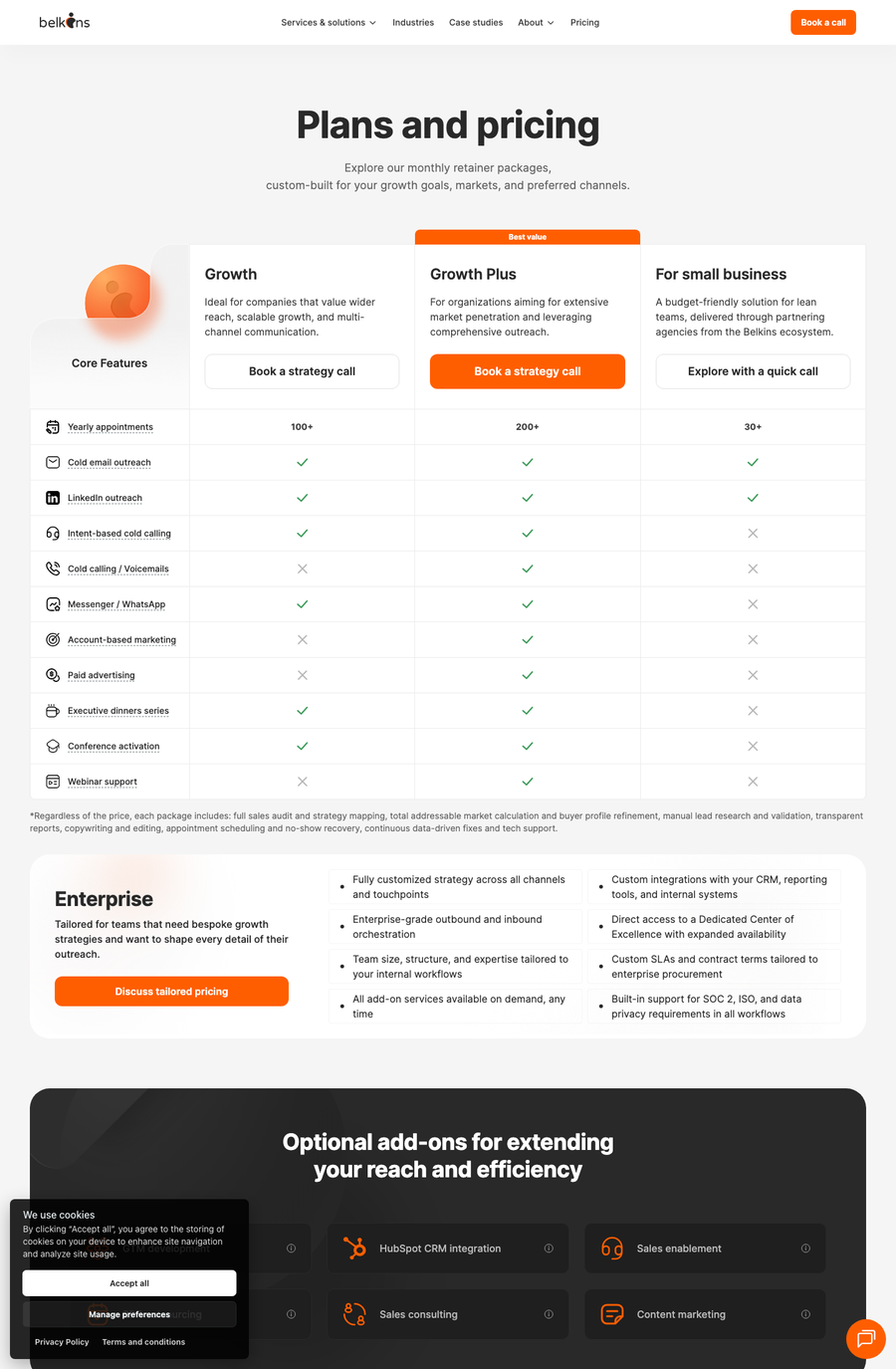
Pricing at this tier is bespoke by convention. Belkins, one of the public mid-market-to-enterprise lead-gen agencies, names four tiers (Growth, Growth Plus, For small business, Enterprise) without publishing dollar amounts; the contract is quote-on-quarterly-appointment-target. Most agencies at this band follow the same shape: published deliverables, gated price.
Group 4: DIY tooling stack
Price band: $300 to $1,500 per month in tooling, plus 20 to 40 hours per week of internal time.
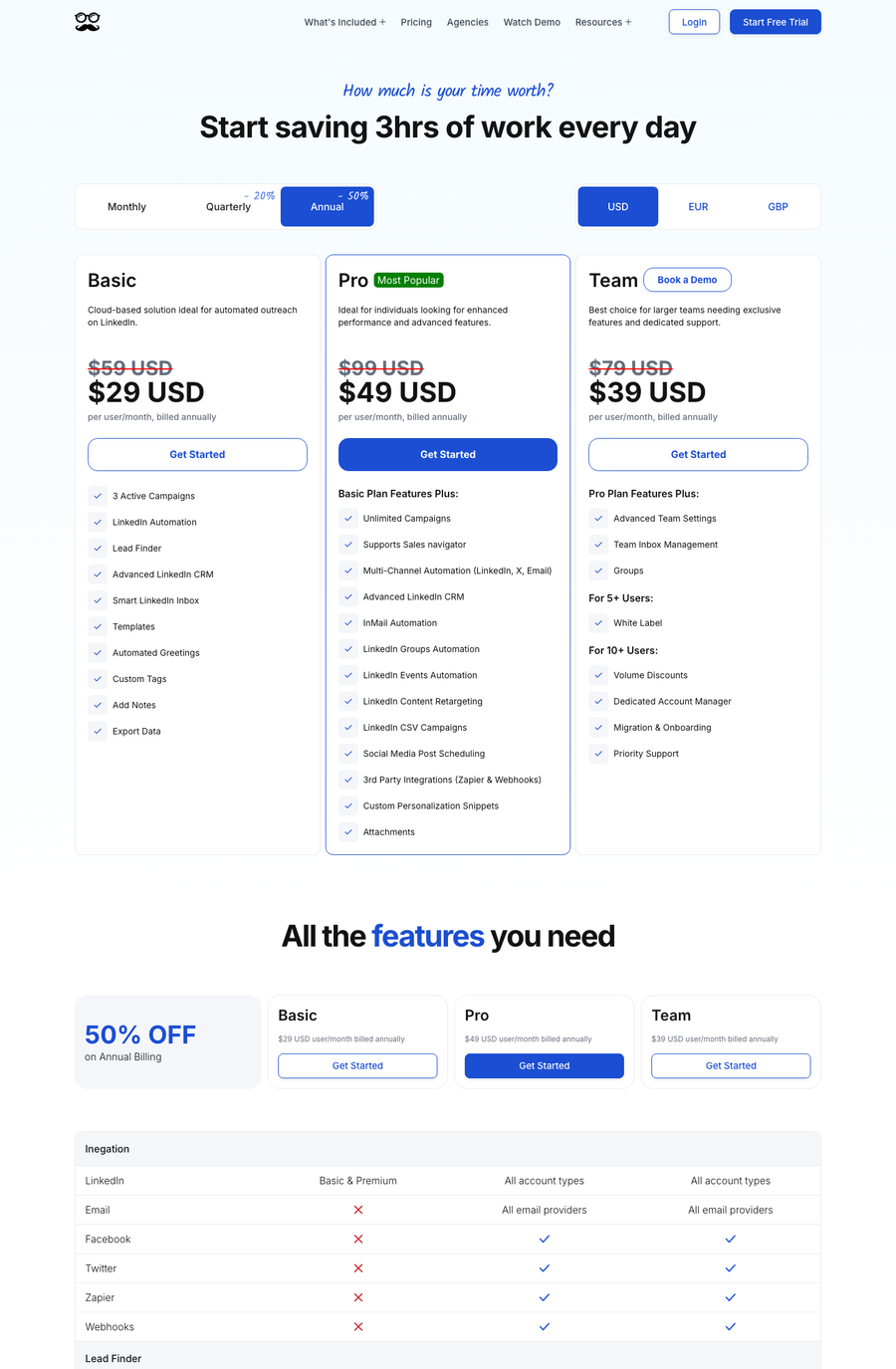
What's in the price: LinkedIn Sales Navigator seats ($99 to $130 per seat per month, multiple seats usually required), an outreach automation tool (Apollo, Lemlist, Lavender or similar at $50 to $300 per user per month), a meeting scheduler, and the buyer's own time on ICP, profile, comments, copy, routing, attribution. The full operating model that an agency would run, run instead by the in-house team.
Verified rate-card pricing in May 2026: LinkedIn Sales Navigator Core at $119.99/seat/month, Advanced at $159.99/seat/month; Meet Alfred at $29–$99/user/month depending on annual or monthly billing and tier; Lemlist Multichannel at $87/user/month for combined LinkedIn + email outreach. A three-seat outreach stack hits $300–$450/month before email infrastructure and enrichment credits. That's the buyer's actual DIY floor before any internal time is counted.
Best for: Founders or operators willing to do the work, especially at very early stage where the discovery loop of doing the outreach yourself is a feature (you learn what your ICP responds to). Also for teams with a part-time internal SDR who can absorb the operational layer.
Not for: Teams whose founder time is worth more than the tool savings. The DIY tier looks cheap on the line item and expensive on the calendar.
What the price actually buys
The headline monthly fee is the visible variable. The workstreams included or skipped decide the actual cost-per-meeting-booked. Same table, different evidence than the agency-vs-tool comparison which cuts the same market by mechanic rather than by price.
| Workstream | Boutique | Full-cycle mid-market | Enterprise | DIY |
|---|
| ICP construction from buyer CRM | Buyer's homework | Included | Included with periodic refresh | Buyer's own work |
| Profile positioning (named operator) | Buyer's homework | Included | Included for multiple profiles | Buyer's own work |
| Comment-led engagement | Rarely included | Included | Included with content support | Buyer's own work |
| Outreach copy and execution | Included | Included | Included | Buyer's own work + tool-templated |
| Reply routing and tagging | Rarely included | Included | Included with CRM integration | Buyer's own work or no system |
| Pipeline attribution against CRM | Acceptance and reply percentages only | Monthly reconciliation | Custom BI integration | Buyer's own work |
A pricing comparison that stops at the monthly fee column misses what each fee actually pays for. A buyer comparing a $2,400 boutique retainer to a $9,000 full-cycle retainer is comparing one workstream of work to six. The boutique fee is not cheaper per unit of work; it covers less work.
The hidden costs that don't show on the pricing page
Six recurring add-ons across our 2025 audit sample:
LinkedIn Sales Navigator seats. $99 to $130 per seat per month. Most agencies require the buyer to provide the seats; multiple seats are usually needed (one per sender profile). On a 3-sender campaign, that's an extra $300 to $400 a month not in the agency quote.
Sender account warming time. Agencies that take new sender profiles seriously need 2 to 6 weeks of warming activity (posts, comments, low-volume connection requests) before outreach. The retainer clock usually starts on day one; the outreach output starts later.
ICP scoping and setup fees. Some full-cycle and enterprise agencies charge a one-time setup fee ($2,500 to $10,000) for the initial ICP build, CRM analysis, and profile rewrite. The pricing page often shows only the monthly retainer.
Per-meeting performance fees. A subset of boutique and mid-tier agencies layer a per-meeting bonus on top of the retainer ($100 to $300 per booked meeting). At volume this can double the headline cost. It also creates a soft incentive to optimise for booked-meeting count over meeting quality.
Reply triage volume tiers. Mid-tier and enterprise retainers usually price by number of active conversations. Past a threshold (commonly 200 active conversations per month), reply triage moves to a higher tier or to per-conversation pricing.
CRM integration setup. For agencies with custom attribution reporting, the integration with the buyer's CRM (Salesforce, HubSpot, Pipedrive) is sometimes billed separately or carries a setup fee. Worth pricing before the first invoice cycle.
The pricing-piece companion on the AI-search side, GEO dashboards pricing 2026, maps the same hidden-cost pattern for a different vendor category. The structure repeats; the line items change.
Before you hire, ask these five questions
Each question is calibrated to surface either a hidden cost or a missing workstream. An agency that can't answer three with specifics is selling the headline fee with the operating model deferred to the buyer.
1. Walk me through your full deliverable list against my ICP, not against a sample brand. Forces the agency to commit to scope on the buyer's specifics, not on a template pitch deck. Surfaces whether ICP construction and profile positioning are in scope.
2. What's the total cost-per-month in year one, including setup, Sales Nav seats, warming, performance fees, and any tier upgrades you'd expect at our volume? Catches the hidden-cost stack. The answer should add up; if it doesn't, the agency hasn't run the numbers on a comparable client before.
3. Show me a cost-per-meeting and cost-per-closed-won figure from a recent client in our category. A real answer has both numbers with sample-period context. A bad answer is reply-rate or acceptance-rate only; those are operational metrics, not commercial ones.
4. What does your attribution methodology look like in month two, and what would my CFO see at the quarterly business review? Forces the pipeline-attribution layer into the open. The agencies that can answer this are the agencies whose contracts get renewed because budget defense is possible.
5. What's the smallest engagement you'd take, and what's the largest you'd recommend a $X-ARR team commit to? The honest answer scopes the agency's actual core-fit tier and rules out the upsell. Agencies that say "we can scale to anything" usually overcharge below their core-fit band and underdeliver above it.
The five-question read pattern generalises across vendor categories once a buyer has been through one of them; the cross-cluster version for AI-search vendor evaluation sits in GEO dashboards versus acquisition, which cuts the same buyer question for the dashboard-and-agency side of the GEO market.
Three rules for picking the tier
Rule one: pick by ICP coverage, not by DM volume. A boutique retainer that promises 1,200 connection requests a month against a roughly-defined ICP costs more per qualified meeting than a full-cycle retainer that ships 600 connection requests against a CRM-sourced ICP. The unit the buyer optimises for is qualified meetings, not connection-request volume.
Rule two: demand the attribution methodology before signing the first contract. The agency that ships pipeline attribution as a deliverable is the agency that can defend the spend at the buyer's quarterly review. The agency that ships acceptance-rate and reply-rate charts only is the agency whose contract gets cut when the line item gets scrutinised.
Rule three: pilot inside one quarter, renew on pipeline, not on engagement metrics. The visible outreach numbers stabilise at month one. The five-workstream mechanic stabilises at month three. The pipeline attribution becomes defensible at month four. A pilot judged at month two on reply rate alone is a pilot judged before the full mechanic has had time to compound.
When the spend is worth it
For B2B teams selling annual contracts above roughly $25,000 ARR per deal and with an ICP they can document from at least 30 closed-won examples, a full-cycle mid-market retainer at $6,000 to $9,000 a month pays back inside two quarters in our 2025 audit sample. The cost-per-meeting math closes at 1 to 2 booked meetings per week, and the LTV math closes faster.
For teams selling lower-ACV or higher-velocity products, the DIY tier or a tooling-led model usually wins. For enterprise teams with three or more parallel buyer personas, the retainer-firm tier carries a procurement and breadth premium that the in-house alternative struggles to match.
Two channel-adjacent options worth pricing into the same conversation: a Reddit AI-search programme for teams whose buyer also research through AI engines, and an X KOL distribution layer for teams whose category narrative needs distribution outside LinkedIn. Both run at retainer bands comparable to the LinkedIn mid-tier and address different surfaces of the same B2B pipeline question.
The wrong band is rarely the wrong fee; it's the right fee for a different buyer profile.
A caveat on the cohort
The 16-audit sample skews toward B2B SaaS (10 of 16), with smaller fintech (3) and crypto-B2B (3) presence. Cost-per-meeting medians generalise better at the mid-tier and enterprise band than at the boutique tier, where the variance is driven by how much of the buyer-side workstreams (ICP, profile, reply triage) are actually in place. Consumer-DTC, e-commerce, and lower-ACV verticals weren't represented in the cohort and likely sit at different bands with a different mechanic; this piece reads as B2B-SaaS-and-fintech-weighted rather than universal.
Frequently asked
How much does LinkedIn lead generation cost per month in 2026?
Boutique outreach shops run $1,500 to $3,000 per month for one to two sender accounts and templated outreach. Full-cycle mid-market agencies run $4,000 to $12,000 for the full operating model. Enterprise retainer firms run $12,000 to $30,000-plus for multi-persona campaigns and dedicated account teams. A DIY tooling stack costs $300 to $1,500 in tools plus 20 to 40 hours per week of internal time.
What's a fair price for a LinkedIn lead generation agency?
The fair price is the band where the agency's actual deliverables match the buyer's needs and where cost-per-meeting closes against the buyer's deal-value baseline inside one quarter. In our 2025 audits, the median cost-per-meeting-booked was $480 at the boutique tier, $190 at the full-cycle tier, $260 at the enterprise tier. The mid-tier wins on cost-per-meeting; the enterprise tier wins on breadth.
Do LinkedIn lead generation agencies charge per lead or per month?
Most charge a monthly retainer. A subset of boutique and mid-tier agencies layer a per-booked-meeting performance fee on top of the retainer ($100 to $300 per meeting). Pure per-lead pricing is rare and usually a signal of either a low-quality outreach shop or a misaligned incentive structure (per-lead pricing optimises for booked-meeting count, not meeting quality).
What's included in a LinkedIn lead generation agency retainer?
At a full-cycle agency: ICP construction from your CRM, profile positioning for one or two named sender accounts, comment-led engagement on a target-account list, outreach copy and execution, reply routing into a tagged inbox, monthly pipeline attribution. At a boutique agency: outreach (the DMs) and a weekly engagement report. The other five workstreams are deferred to the buyer.
Are LinkedIn lead generation agencies worth the cost?
For B2B teams selling annual contracts above ~$25,000 ARR per deal with a documentable ICP, a full-cycle retainer at $6-9k/month pays back inside two quarters in our 2025 sample. For lower-ACV or higher-velocity products, the DIY tier or tooling-led model usually wins. The answer depends on deal value, ICP clarity, and sales follow-up discipline; the article above is built to help the buyer make this call without a discovery call.
How do LinkedIn lead generation agency contracts work?
Most full-cycle and enterprise agencies require a 3-month minimum to allow the operating model to stabilise (outreach numbers hit at month one, ICP and profile mechanics stabilise at month three, pipeline attribution stabilises at month four). Annual contracts are common at the enterprise tier. Boutique shops often work month-to-month but the cost-per-meeting at that flexibility usually sits higher than at the mid-tier retainer.
What hidden costs come with LinkedIn lead generation agencies?
Six recurring ones: Sales Navigator seats ($99-130/seat/mo), sender account warming time during which the retainer is running but outreach hasn't started, ICP scoping and setup fees ($2,500-10,000 one-time at some agencies), per-meeting performance fees, reply-triage volume tier upgrades past ~200 active conversations, and CRM integration setup for custom attribution. Worth pricing all six before the first invoice cycle.
Methodology
The cohort numbers come from 16 LinkedIn lead-gen vendor audits NotPeople ran or sat in on in 2025. Vertical mix: B2B SaaS (10), fintech (3), crypto-B2B (3). Each audit reviewed one or more vendor quotes against the buyer's ICP, deal-value baseline, and pipeline target. Cost-per-meeting-booked medians are the simple median across cohort members at each tier; tier price bands are the min and max disclosed monthly retainer in each tier. Public tool and agency pricing in this piece is verified from vendor rate cards (LinkedIn Sales Navigator, Meet Alfred, Lemlist, Cleverly, Belkins) in May 2026.
If you want this priced against your specific ICP and pipeline targets
If the article leaves the math feeling abstract for your team, we can run the pricing audit on a call: your deal value, your current cost-per-meeting baseline, the four tier-group fits against your ICP, and the cost-per-meeting math each tier should hit. Twenty minutes, no charge.