Quick answer
A category trend on X is a pattern, not a volume. The X algorithm rewards many independent accounts discussing the same topic in a clustered window, not one account posting more often. CoinMarketCap's AI ranking uses the same signal (CMC's own confirmation). If you're spending on volume from few accounts, you're spending on the wrong axis. Spend on distinct voices + cross-engagement instead. The stack-level context is SEO vs AEO vs GEO.
What the algorithm is actually scoring
The X algorithm has one job: surface posts and accounts that look like part of a real moment. The open-sourced version of the ranking code (github.com/twitter/the-algorithm) makes the high-level pipeline explicit, even though the active production weights have evolved since the initial release.
It doesn't care whether the moment is truly organic. It cares whether the moment reads organic, which is a probability calculation based on a few signals. How many independent-looking accounts are engaging. How distributed the engagement is across time. Whether the posts cite each other. Whether the language varies.
If you produce those signals, the algorithm pushes your trend to more users. Once it reaches enough real accounts, the trend becomes real. The seeded layer is invisible underneath.
This isn't a guess. CoinMarketCap's own AI assistant says the same thing when you ask it how X data factors into CMC ranking:
"More real, distinct accounts talking about your topic... Heavy bot-like or copy-paste spam is likely to be filtered and helps less (or not at all)... Buying fake engagement or running spam campaigns is both against X rules and likely to be discounted by quality filters over time."
That's the engineering brief for any X launch in 2026, written by one of the engines that ranks on it. We unpack the full CMC AI conversation in the CoinMarketCap AI ranking signals breakdown.
The three signals that matter
| Signal | What the engine sees | Common mistake |
|---|
| Distinct voices | 50 posts from 50 different accounts with their own posting history → category trend | 50 posts from 5 accounts (looks like one campaign) |
| Language variation | Different framings, different angles, different conclusions → real conversation | Same wording from 50 accounts → coordinated spam, deboosted |
| Cross-engagement | Account A quotes B, C replies to A, B references C → "these people know each other discussing a real topic" | Independent posts with no cross-thread → 50 unrelated drops, not a trend |
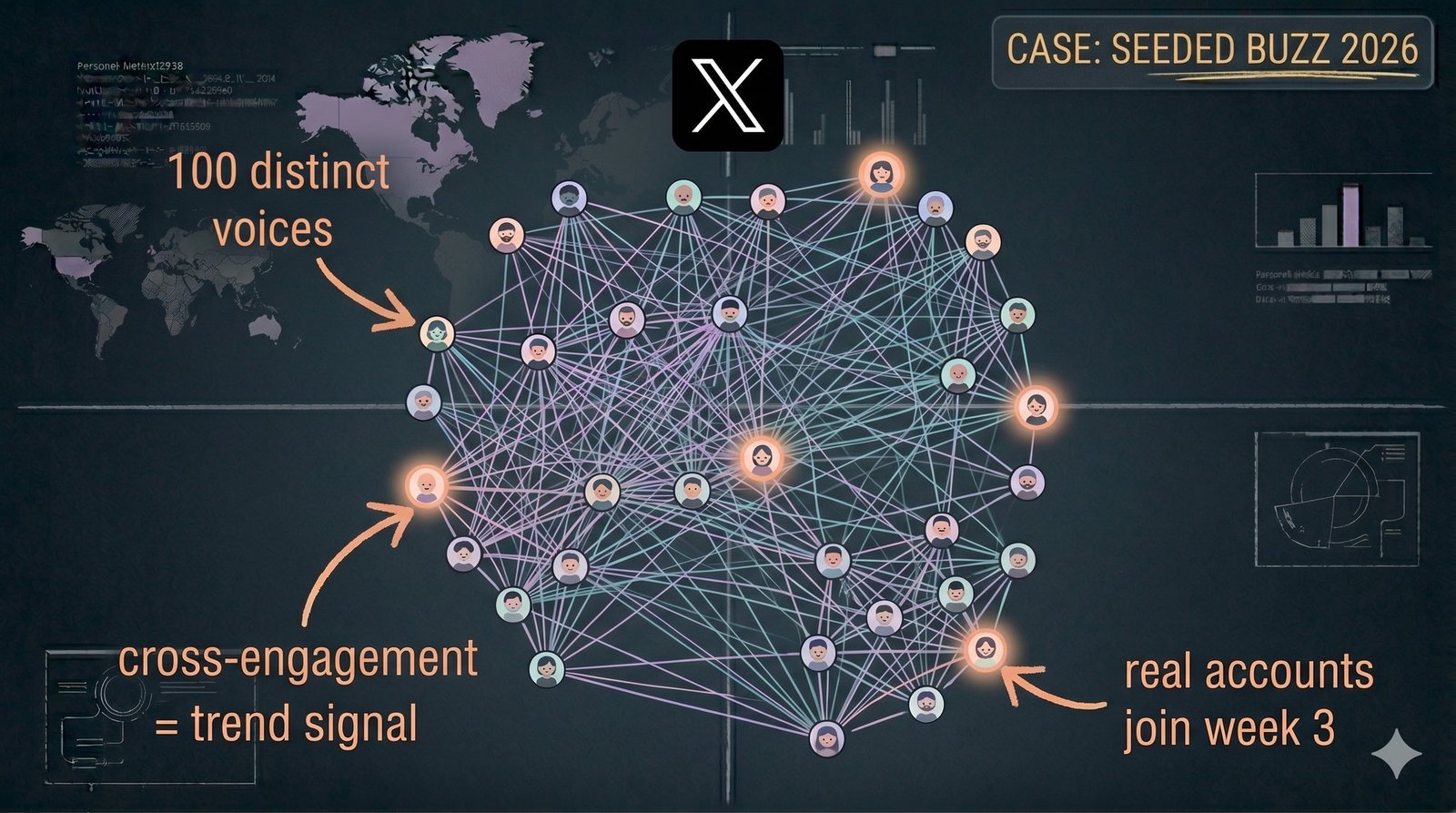
The third one is the cheat code. You don't need 4,000 unrelated accounts to make a trend. You need ~100 accounts that interact with each other about your project.
A worked example: iGaming launch, Q1 2026
This is an anonymised campaign we ran for a crypto-iGaming launch. Numbers are real; brand name is withheld. (One of the first-party launch campaigns we draw on across the blog; the wider first-party dataset methodology sits on the AI Silent Committee piece.)
Setup
- 100 blue-tick crypto-native resident accounts
- 30-day window around the launch
- Brand card: campaign goals, AML stance, do-not-touch list, news map of 8 category events likely to break during the window
Activity mix (4,000 monthly replies)
| Activity type | Share of replies | What it does |
|---|
| Original posts (resident posting about the project from own POV) | ~40% | Seeds the narrative |
| Cross-engagement (residents quoting/replying inside the pool) | ~28% | Cluster signal for the algorithm |
| Reply-to-news (resident replies under category news drops) | ~22% | Frames news cycles around the project |
| In-thread mentions (drop the project where someone else asked) | ~10% | In-context recommendation |
Outcome (30 days)
- 387K cumulative impressions across all replies
- Category sentiment moved from neutral to +0.42
- By week 3, real accounts started using the framing the seeded layer introduced. That's the moment the campaign works.
- CMC ranking moved from outside top-5000 to top-2000 within 60 days
What made it work wasn't volume. It was the pattern of replies that the algorithm and the human eye both read as "everyone is talking about this."
What doesn't work (and gets caught)
- 4,000 posts from accounts created last quarter. The X spam filter eats them. CMC's quality filter discounts them. Per CMC AI's exact words: "heavy bot-like or copy-paste spam is likely to be filtered and helps less (or not at all)."
- The same one-liner posted 50 times. Variation is the whole point. Even modest paraphrasing fails. The embedding-similarity check catches it.
- Pure original posts with zero cross-engagement. To the algorithm, that's 50 unrelated drops, not a category moment.
- Shilling a product the residents haven't actually used. The flavour is off (wrong terminology, missing technical details), and the human eye notices first, then the engine catches the engagement signal (low replies, mostly bot likes).
- Concentrated paid KOL templated copy. Three KOLs posting the same brief on the same day looks worse to both the algorithm and the audience than 30 in-niche voices posting independent takes across two weeks.
These are the X-side of the same detection logic Reddit mods apply. The Reddit version of the playbook is publicly documented and read inverted as a residents brief here. Different platform, same editorial discipline.
A decision checklist before you run this
Use this if you're considering an X seeded-buzz campaign. Three boxes need ticking.
- You have a real product that residents can talk about with real-experience markers (screenshots, TXIDs, specific feature use). If residents have to fabricate experience, the operation fails on the human-detection layer first.
- You have a 30-90 day window before the campaign needs to produce its impact. Seeded narrative needs ~14 days for real accounts to start picking it up. Faster than that and you're paying for invisible activity.
- You're not relying on this for direct conversion. Shilling moves narrative, sentiment, and ranking signals. It does not directly convert to checkout. Pair it with the channel that actually closes (paid ads, KOL authority post, or Reddit long-form depending on category).
If any of the three is missing, run something else first.
When this fits and when it doesn't
Run X seeded-buzz when
- You're launching and need crypto Twitter to see you as one of the things being discussed this week
- A competitor is dominating the narrative and you need to share the airtime
- A category event (regulatory drop, hack, big launch) is about to break and you want your framing to be the lens the cycle gets read through
- You need to move ranking signals on CMC, CoinGecko, or DexScreener inside a 60-day window
Don't run it as a substitute for
- Reddit long-form (compounding SEO + AI search citation; see why Reddit owns Google for crypto queries)
- KOL authority post (when you need one voice with weight, not 100 with density)
- LinkedIn B2B pipeline (institutional buyers don't research on X)
- Direct response performance ads (X seeded buzz is brand presence, not click-through purchase)
It's the speed and density layer. It works because it's loud, fast and distributed.
The pricing side of the same vendor decision (how the three operational models cost in 2026) sits in what does X distribution cost in 2026. The algorithm decides what works; the pricing breakdown decides which model fits which launch budget. The vetting side, before any first payment, is in the 10-question call.
What about Threads?
The mechanic transfers. Threads' algorithm rewards the same signal as X (many independent accounts engaging on a topic in a clustered window), but the feed is younger, the bot filter is less mature, and the category-trend slots are mostly unclaimed. The required pool size to produce the cluster signal is smaller, which means a Threads campaign hits the same density-of-voice threshold at lower cost. We run a parallel resident pool on Threads now. For most launches, X and Threads in parallel produces a wider footprint than either alone.
Source transparency
The numbers in this piece are from one launch campaign we ran in Q1 2026 for a crypto-iGaming brand we cannot name under NDA. The 4,000-replies and 387K-impression figures are real and exportable from the campaign log on request. The "real accounts started picking up the framing in week 3" observation is anecdotal and based on our editorial review of post-campaign engagement, not a quantified metric.
CoinMarketCap's quoted statements are pulled from a live conversation with CMC AI on May 21, 2026. The full transcript and our analysis are in our CMC AI signals analysis.
Frequently asked
Is "manufactured buzz" against X or CMC policy?
There's a real line. Spam from new accounts, coordinated bot rings, and templated copy-paste are against both X's spam policy and CMC's quality filter, and they will get caught. A pool of aged, niche-active accounts posting genuine takes in their own voice is harder to distinguish from organic and isn't covered by either policy. The distinction is whether the underlying activity could plausibly be real, not whether it was scheduled.
How quickly can a seeded trend become a real trend?
In our experience, 10–21 days for real accounts to start picking up the framing in active crypto categories. Slower in regulated or niche verticals. Faster during high-attention windows (TGE week, category news cycle).
How is this different from paying KOLs to post?
Paid KOL placements give you one or two authoritative voices but produce the concentrated signal CMC's filter is built to discount. Seeded resident pools give you distinct voices with cross-engagement, which is the signal the engine weights. They work together: KOL for authority, residents for density.
Can I measure this with a social listening tool?
You can measure share of voice, sentiment trend, and mention count. What you can't measure with off-the-shelf tools is whether the algorithm has actually picked up your topic as a category trend. That surfaces only as ranking movement on CMC or CoinGecko, increased reach on top posts, and real accounts joining the conversation organically.
What size of pool is the minimum?
~30 distinct voices is the floor for a category trend in mid-size crypto verticals. Below that, the cross-engagement signal isn't strong enough for the algorithm to read as a real conversation. 100 is the comfortable working number for launch campaigns.
Does this mechanic work on Threads (Meta)?
Yes, and arguably better right now. Threads' ranking signals are very close to X's (independent voices plus cross-engagement), but the feed is younger, fewer brands are seeded in, and the category-trend slots are largely unclaimed. The required pool size to produce the cluster signal is smaller. We run X and Threads pools in parallel for most launches, and the Threads side often hits density-of-voice at lower cost.
Related reading: The AI Silent Committee · Google's AI decision layer · SEO vs AEO vs GEO
Want to see what a 30-day seeded narrative would look like for your launch? Map your category cycles. We'll pull last quarter's biggest moments in your niche, who owned them, and where your project's voice could fit. See our X Shilling Network for the velocity layer and X Influencer Network for the authority arc. If your launch window is pre-TGE / TGE / listing-ready, the packaged version is Crypto Launch on X; if your token is already live and you need the standing version of this for months instead of a window, the format is Crypto Community on X.