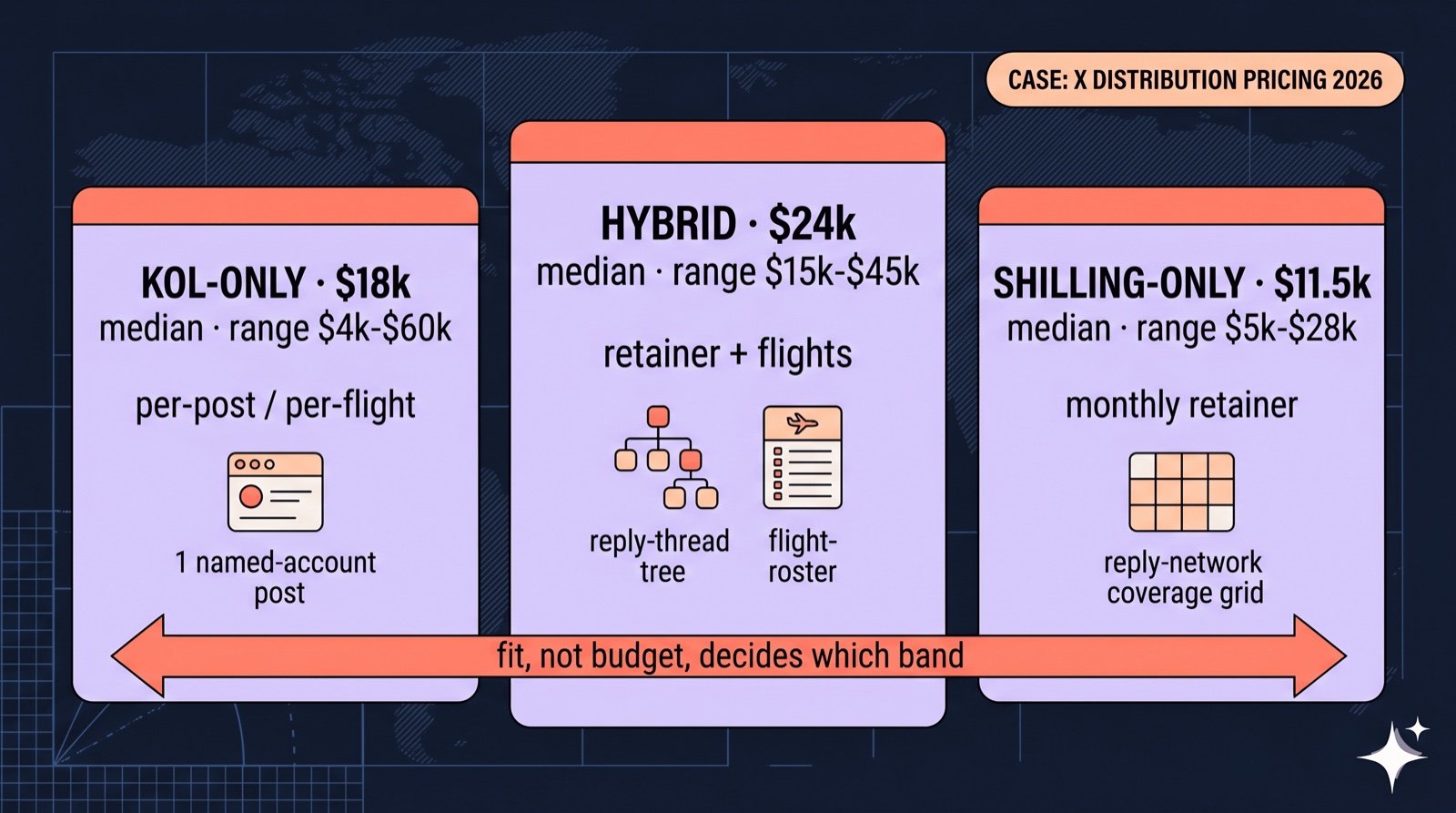
Across the 12 X-distribution vendor audits we ran or sat in on between Q3 2025 and Q1 2026, KOL-only quotes landed at a median of $18,000 a month with a range from $4,000 to $60,000. Shilling-only quotes landed at $11,500 median with a range from $5,000 to $28,000. Hybrid resident-network plus KOL integration ran at $24,000 median with a range from $15,000 to $45,000. Three different price bands. Three different things you actually buy. The buyer question that decides which band is the right one to compare against is the launch type, not the budget ceiling.
Quick answer
X distribution vendor pricing in 2026 splits across three operational models with three cost shapes: KOL-only ($4,000-$60,000/mo, priced per-post or per-flight on audience reach), shilling-only ($5,000-$28,000/mo, monthly retainer for reply-network operator coverage), and hybrid resident-network plus KOL integration ($15,000-$45,000/mo, retainer for coordinated outcome). The right model depends on what the campaign is for: founder-led pre-launch buys KOL audience-trust signal, coordinated launch moment buys hybrid coverage, ongoing distribution buys shilling retainer. A buyer comparing one model's quote against another model's market band is comparing the wrong number.
The three pricing models, at a glance
Same table you'd want a vendor to send you on first email.
| Model | Median (USD/mo) | Range | Pricing primitive | Best fit |
|---|
| KOL-only | $18,000 | $4,000-$60,000 | Per-post or per-flight on named influencer accounts | Founder-led pre-launch buying audience-trust signal from named voices |
| Shilling-only | $11,500 | $5,000-$28,000 | Monthly retainer on reply-network operator coverage | Ongoing-distribution programme that needs continuous category presence |
| Hybrid resident-network + KOL integration | $24,000 | $15,000-$45,000 | Retainer + KOL flight integration for coordinated outcome | Coordinated launch moment (token launch, product GA, fundraise announcement) |
The bands widen at the high end because two factors compound: number of accounts in the network or KOL roster, and how aggressive the launch timing is. A 30-voice KOL flight inside a 72-hour launch window prices at the top of the KOL band. A 6-voice flight over a quarter prices at the bottom.
Three quick reads on the table before the model-by-model breakdown. First, the medians cluster within a 2x range of each other (the most expensive model is roughly 2x the cheapest), but the high-end of each range stretches further (KOL high-end is 15x its low-end, shilling 5.6x, hybrid 3x). Second, the pricing primitive differs across the row (KOL on reach, shilling on coverage, hybrid on outcome), so the unit-economic comparison has a structural shape rather than a numerical one. Third, the best-fit column maps to a launch type, not to a budget tier; the right model isn't usually the cheapest model.
KOL pricing: per-post or per-flight on audience reach
The KOL-only model prices by the named voice and the volume of content from that voice. A "flight" in vendor language is a campaign window where a roster of pre-agreed influencers posts coordinated content (usually 1-3 posts per influencer, sometimes a thread plus reply engagement). Pricing primitives vary across vendors but condense to two shapes.
Per-post pricing. Negotiated per-influencer based on follower count, vertical match, and engagement metrics on prior posts. Crypto-native vendors often quote per-post in the $2,000-$8,000 band per mid-tier KOL (50K-200K followers), scaling to $15,000+ for top-tier voices (500K+ followers). A flight of 6 KOLs at mid-tier with one post each is the $12,000-$48,000 quarterly band that produces the $4,000/mo low-end on the table above.
Per-flight pricing. Bundled across multiple KOLs for a defined campaign window. The vendor handles roster assembly, content coordination, and post-flight reporting. The hybrid shape (one flight per month inside a quarterly contract) is common in crypto; ongoing per-flight retainers in the $15,000-$30,000/mo band are typical for active-launch programmes.
Public benchmarks support the same per-post primitive. CryptoKOLz, a 2026 crypto-KOL marketplace, publishes per-post bands by follower tier: $100–$1,500 (10K–50K), $1,500–$7,500 (50K–200K), $7,500–$25,000 (200K–1M), $25,000–$150K+ (1M+). ZachXBT's April 2022 pricelist leak catalogued the same primitive at lower nominal numbers across 114 named accounts (19.27M followers combined): Altcoin Gordon at 86K followers at $2,500/post, Zuby at 544K at $8,000, Lindsay Lohan at 8.27M at $25,000. Four years on, the per-post structure is unchanged, mid-tier bands have roughly doubled, and top-tier nominal pricing sits flat.
The unit-economic question for the buyer is whether reach to the KOL's audience produces buyer-relevant attention. The DeFi case below shows the failure mode when it doesn't.
Shilling pricing: monthly retainer on reply-network operator coverage
The shilling-only model prices by the operator-network's coverage scope and the response volume the retainer covers. Pricing primitives are simpler than the KOL side: monthly retainer with a defined scope (number of subreddit/topic threads engaged per week, number of network accounts active, AI-citation tracking included or excluded).
Five variables drive the number inside the band.
Network size. The reply-coverage density vendors can credibly hit scales with account count: a 6-account network typically covers 2-3 topics with daily presence; 12-15 accounts (cohort median) covers 4-6; 20+ extends to 8-10 topics or multi-language coverage. The cost driver is the warming and credible-posting cadence each aged account requires to survive ban waves like Reddit's mid-May 2026 GEO-spam crackdown, not raw headcount.
Coverage scope. Each additional topic adds dedicated thread-triage hours (subreddit and query monitoring, reply-context loading, per-thread research) on top of the baseline operator time. Three topics is the floor; coverage past five typically requires both a wider operator pool and a weekly query-set refresh as the news cycle moves. Vendors quote a topic-cap and bill overage at the per-incident rate.
Response volume per week. The cap defines operator capacity: roughly 40 thread engagements per week is what a cohort-median 12-15 account pool sustains before pattern-detection risk forces accounts into rotation. "Up to 100 per week" requires either a 20+ account active network or a hybrid model where paid KOL posts absorb part of the share-of-voice load. The honest quote names a number and the overage rate; "unlimited within scope" usually means the operator decides what counts.
Reporting cadence. Monthly is standard; weekly with AI-citation probes adds 10-20 per cent to the base retainer. The reporting-cadence question maps directly to how to read an X distribution vendor report. The higher-cadence quotes typically include the real metrics that defend budget at renewal.
Vertical and language coverage. Crypto and iGaming run hotter than B2B SaaS on incident-density for the same brand size; multi-language coverage triples the operator-pool cost. Both push retainers toward the high end of the $5,000-$28,000 band.
The unit-economic question for shilling pricing is whether continuous reply-network presence produces compounding category-conversation share. It usually does on a longer time horizon (3-6 months minimum) and rarely on shorter ones.
Hybrid pricing: retainer plus KOL integration for coordinated outcome
The hybrid model bundles a shilling-style retainer with KOL flights scheduled inside it. The operator-network provides ongoing coverage; the KOL flights provide named-voice amplification at specific moments (launch days, news cycles, partnership announcements). The pricing primitive is coordinated outcome: retainer-plus-flight bundled into a single monthly number with the KOL flight count defined in the contract.
The $24,000 cohort-median sits in the middle of the $15,000-$45,000 band. The cohort-median package typically includes a 12-15 account aged reply network plus 1-2 KOL flights per month inside the retainer scope. Buyers paying at the high end ($35,000-$45,000) are usually running 20+ account networks with 2-3 KOL flights per month and active news-cycle reactivity.
The unit-economic question for hybrid is whether the coordination layer between the two channels produces outcomes that neither would produce alone. The pattern observed in the audit cohort: coordinated launches consistently produce higher peak-day reach than KOL-only launches, and the retainer layer holds the category-conversation share past launch day where KOL-only campaigns drop off within a week.
The DeFi case: right price, wrong model
A DeFi protocol we audited in Q4 2025 had a $42,000/month KOL-only contract running through a launch quarter. The contract delivered 8 KOL posts per week from accounts averaging 180,000 followers. Total impression count for the quarter: 14 million. The headline numbers passed internal sign-off three months running.
Pipeline-side downstream attribution showed 260 wallet-tracked sign-ups attributable to X over the same window. The same brand was running a $8,000/month Reddit residency programme alongside the X campaign. That programme produced 2,140 wallet-tracked sign-ups over the same window. The KOL spend was 5.25x the Reddit spend producing roughly 12 per cent of the sign-ups.
The KOL contract wasn't a bad contract. The price was within market band, the impression count was real, the KOL accounts were credible. The contract didn't fit the goal. The buyer had bought audience-trust signal (which KOL produces) when the goal was trackable wallet sign-ups (which the operator-network model produces more cost-effectively on a per-sign-up basis).
The reframe for the next quarter: cut KOL spend to $12,000 for one launch-week flight, increase Reddit residency to $14,000, add a $9,000 X shilling retainer for ongoing category presence. Total monthly spend dropped from $50,000 to $35,000; wallet-tracked sign-ups over the following quarter rose to 2,800 (vs the prior 2,400 across both channels). Right model, right price.
The unit-economic shape of cross-channel comparisons like this lives in the citation playbook for Perplexity, ChatGPT and AI Overviews.
Which model fits which launch type
Three launch types map to three vendor models in our cohort. The fit isn't absolute, but the pattern recurred enough across 12 audits to be the default-recommendation framework.
| Launch type | Best-fit model | Why |
|---|
| Founder-led pre-launch (token, product GA in 2-4 months) | KOL-only | Audience-trust signal from named voices is what the pre-launch needs; flight-based pricing matches the campaign window |
| Coordinated launch moment (token launch day, product GA day, fundraise announcement) | Hybrid | The retainer-plus-flight bundle delivers peak-day reach plus post-launch category-conversation hold; outcome-priced |
| Ongoing distribution (post-launch, category-presence maintenance, AI-citation share growth) | Shilling-only | Monthly retainer matches the compounding-presence pattern; no flight expense for periods without launch moments |
Buyers running ongoing distribution who buy KOL-only typically overspend by 50-100 per cent for the outcome they get (the DeFi case is one). Buyers running a coordinated launch moment who buy shilling-only typically underspend on peak-day reach and miss the launch-window amplification. Buyers running founder-led pre-launch who buy hybrid typically pay for retainer capacity they're not using in the pre-launch period.
The cross-platform read on the same fit-not-budget logic is in the Reddit reputation management pricing breakdown, and the B2B-side parallel is in the LinkedIn lead-generation agency pricing piece. Same fit-decides-model framing applied to different surfaces. The separate question of how to tell which of the three models the vendor in front of you is actually running is in the 10-question vetting call.
A caveat on the cohort
The 12-audit cohort skews crypto and fintech (8 of 12). Consumer and B2B SaaS vendors operate in narrower bands at the low end of the ranges and rarely see the high-end six-figure quarterly flights crypto buyers see. Verticals outside the cohort (healthcare, education, government) typically use generalist influencer agencies rather than X-specialist vendors and price differently from the bands here. The fit-not-budget framing still applies; the band numbers should be read as crypto-and-fintech-weighted rather than universal.
Before signing, ask these 5 questions
These run on any X distribution vendor quote at any of the three models. The answer pattern reveals more than the proposal PDF.
1. What's the price primitive (per-post, per-flight, monthly retainer, or bundled-coordinated-outcome) and what's specifically included at the quoted band? Forces the model definition into the open. A vendor that won't name the price primitive cleanly is quoting an unclear scope.
2. For KOL or hybrid: what's the roster of named accounts in the flight and what are their follower counts plus prior-campaign engagement rates? Real answer cites named handles and per-account history. A vendor that says "premium tier accounts" without naming them is reserving the right to backfill the roster with cheaper KOLs after the contract signs. A buyer-side sanity check on the roster: Antonia Ylly's open-source kol-pricing tool classifies any X handle by tier and outputs an expected cash range per collab type. Self-hosted, uses your own X + LLM API keys; run it on each named account in the proposed roster and compare the per-post estimate against the vendor's quoted line.
3. For shilling or hybrid: what's the median account age in the active reply network and what's the documented incident log over the last 90 days? Real answer cites the age in months (12+ is the survival floor per the ban-wave parallel on Reddit) and names at least one incident in the period. Networks with no incidents are either too new or too small to have been wave-detected.
4. What's the AI-citation share probe cadence and how does it baseline against pre-engagement? Real answer reports the probe set (20-50 brand-name prompts on Perplexity, ChatGPT, Claude, AI Overviews) and a weekly cadence with month-1 baseline. Vendors that don't measure AI-citation share are operating in 2026 without the downstream-outcome instrument.
5. What does cancellation look like, and what's the evaluation-window option before annual lock-in? A 3-month evaluation window with monthly opt-out is the band-standard. Vendors quoting 12-month lock-in only are vendors confident the outcome won't show before the 12 months are up.
A 15-minute pricing-vs-fit audit
Seven yes/no checks on any X distribution vendor quote you've already received. Run during a discovery call or against the proposal PDF. Five or more yes answers means the quote is honest enough to negotiate.
- Does the quote name the price primitive (per-post / per-flight / monthly retainer / bundled outcome) explicitly?
- Does the quote name the included scope (number of KOLs, number of network accounts, number of weekly engagements) explicitly?
- For KOL or hybrid: does the quote name the roster of accounts and their per-account history?
- For shilling or hybrid: does the quote name the median account age in the network and the incident log?
- Does the quote include AI-citation share probe in the reporting cadence?
- Does the quote separate the KOL flight cost from the retainer cost (so the buyer can compare against each model's market band separately)?
- Does the quote offer a 3-month evaluation window with monthly opt-out before any annual commit?
A quote that scores three or fewer needs another iteration from the vendor before signing. The same vendor-vetting discipline at the cross-cluster vendor-eval layer is in the Reddit reputation pricing breakdown and the LinkedIn lead-generation agency pricing piece; the model labels change, the audit shape doesn't.
For buyers comparing X distribution against alternative surfaces, the X shilling network and the X KOL service are the two product surfaces for the two pure-play model options, and the Reddit resident network is the cross-cluster alternative buyers in crypto, fintech, and consumer often run alongside. For buyers specifically scoping a token launch window (pre-TGE warming through listing-day amplification), the launch-window packaged version of the X pool is Crypto Launch on X, with the same model applied to a 21-day cycle and a $3K / 5,000 touches entry tier.
Frequently asked
How much does X distribution cost in 2026?
Three bands by model. KOL-only ranges $4,000-$60,000/month with a $18,000 cohort median, priced per-post or per-flight on named influencers. Shilling-only ranges $5,000-$28,000/month with $11,500 median, priced as monthly retainer on reply-network operator coverage. Hybrid resident-network plus KOL integration ranges $15,000-$45,000/month with $24,000 median, priced as coordinated-outcome bundle. The buyer's actual quote depends on which model fits the launch type, not on which model the vendor pitches.
What is the difference between KOL and shilling pricing?
KOL prices on audience reach: per-post or per-flight on named influencer accounts, with the rate scaling by follower count and prior-campaign engagement. Shilling prices on operator coverage: monthly retainer for a reply-network whose scope is defined by network size, target topics, and weekly engagement volume. KOL is flight-shaped (campaign windows); shilling is retainer-shaped (continuous coverage). They produce different outcomes: KOL produces named-voice signal, shilling produces category-conversation share.
How much should a crypto launch spend on X distribution?
Depends on launch type. A founder-led pre-launch in the 2-4 months before token launch typically runs KOL-only at $15,000-$35,000/month for a 6-12 KOL roster. A coordinated launch moment (launch day plus the week around it) typically runs hybrid at $25,000-$45,000/month for the launch quarter. Ongoing distribution post-launch typically runs shilling-only at $8,000-$18,000/month. Crypto-vertical buyers in our cohort overspent on KOL-only relative to outcome more often than they overspent on the other two models.
What does a typical X reply network retainer cost?
The shilling-only model cohort median is $11,500/month for a 12-15 account aged reply network covering 3-5 target topics with monthly reporting. The range $5,000-$28,000/month reflects network size (6 accounts to 30+ accounts), coverage scope (3 topics to 10+ topics), and reporting cadence (monthly to weekly with AI-citation probes). Verticals with higher incident density (crypto, iGaming, regulated fintech) sit toward the higher end for the same scope.
Should I hire KOL or shilling for my product launch?
Depends on the launch type and the outcome you're optimising for. KOL fits founder-led pre-launch programmes where audience-trust signal from named voices is the primary asset being built. Shilling fits ongoing distribution programmes where category-conversation share is the primary asset being built. For a launch moment specifically (the day of and the week around), hybrid usually fits better than either pure-play because it bundles peak-day amplification with post-launch hold.
How do X distribution vendors price their service?
Most vendors price-on-request rather than publishing a rate card publicly, because the three operational models cost differently and the right quote depends on the buyer's launch type, vertical, and campaign window. The price primitives across the market are: per-post (KOL), per-flight (KOL bundled across multiple voices in a window), monthly retainer (shilling), and bundled coordinated-outcome (hybrid). A vendor that quotes a single round-number per-month figure without specifying primitive is usually quoting an opening offer rather than a fitted scope.
What is included in an X distribution monthly retainer?
For shilling-only retainers: aged reply-network accounts (12+ months old per the survival floor), defined topic-coverage scope, weekly engagement-volume cap with overage rate, monthly or weekly reporting cadence with AI-citation share probes where included, per-account incident log, and a cancellation or evaluation-window clause. For hybrid retainers: all of the above plus a defined number of KOL flights per month with the roster named in contract. KOL-only contracts are typically per-flight rather than monthly retainer; if quoted as a monthly retainer, the vendor should specify the flight-count-per-month equivalent.
Methodology
The cohort medians and ranges in this piece come from 12 X-distribution vendor audits NotPeople ran or sat in on between Q3 2025 and Q1 2026. Vertical mix: crypto (5), fintech (3), B2B SaaS (3), consumer-tech (1). Each audit reviewed a single vendor's quote against the buyer's launch type and pipeline goal. Median monthly cost is the simple median of disclosed retainer or per-flight quotes converted to a monthly rate; ranges are the min and max disclosed in the cohort.
If you've received an X distribution quote on the table
If you've received an X distribution vendor quote and want a pricing-vs-fit check before signing, we can run the seven-question audit on the proposal. The methodology works on any of the three vendor models, including quotes for our own shilling network or KOL service. The audit is the same shape regardless of who sent the quote. Twenty minutes, no charge.